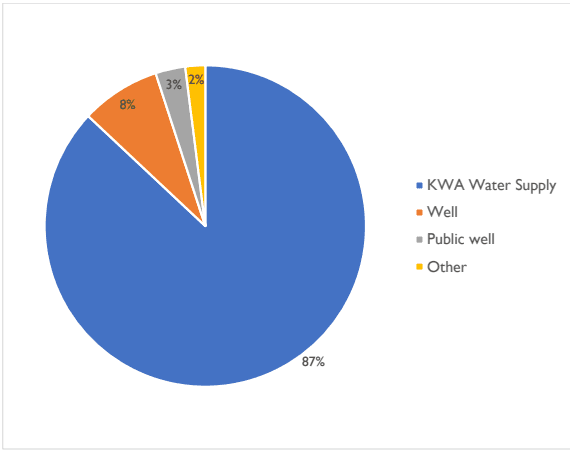
The corporation depends on Kerala Water Authority (KWA) as its main source for water supply. From the data collected through primary survey, this amounts to 87% of the total households in the Kochi corporation area. Only 8 % of households depend on well as the main source of water. The saline and brackish water especially in the western areas of the corporation makes it unsuitable for the construction of wells. While it is seen that 87% of the total households have access to water supply system, 70% of them are dependent only on KWA water supply. This underlines the importance of water supply system to cater to the needs of drinking water supply to the people of Kochi Corporation.
Figure 10:1shows the sources of water supply in Kochi Corporation. Other sources for drinking water are met with ground water and tankers as well. Along with water from KWA, people also depend on other sources due to the unavailability and seasonal scarcity.
362
Figure 10:1 Main water supply sources in Kochi Corporation area Source: Socio – Economic Survey, 2019
Kochi Municipal Corporation
WATER SUPPLY
Chapter 10Water Supply
10.1
Introduction
The management of drinking water supply in Kerala obtains importance at the policy level due to the state’s paradoxical situation where there is scarcity in the midst of plenty, as well as the growing demand for water due to the high population density and changing water use habits. Similarly, the high population density, unchecked urbanisation, rising rate of per capita waste generation, changing waste streams and poor waste handling habits have resulted in a complex waste management scenario in Kerala. In the water supply sector, there were a number of reforms from time to time on aspects of governance, planning principles, supply norms, implementation and management of schemes.
Supply of clean drinking water is very crucial for any city’s un-interrupted functioning. The growing cities over time have become very water demanding and this is seen in the case of the metropolitan cities. This chapter briefs about the existing water supply network, water treatment plants, physical loss, demand-supply gap, problems faced with regards to latter.
The KWA is the largest institutional entity in the field of water supply, and implemented thousands of small, medium and large urban and rural piped water supply schemes. It was established in 1984 for the development and regulation of water supply and waste water collection and disposal in Kerala. Kerala Water Authority deals with the Planning, Designing, Implementation, Operation and Maintenance of the water supply projects in Kochi.
Climate, Rainfall and Groundwater
361
Climate and rainfall: Ernakulum district has wet monsoon type of climate. The district experiences heavy rainfall during southwest monsoon season followed by northeast monsoon, while during other months rainfall is considerably lower. Nearly 100 years of data (1901 – 1999) show that the annual rainfall averages 3359mm and ranges from 3233mm to 3456mm at different places of the district. The district is drained by the Periyar River and its tributaries on the north and Muvattupuzha River on the south.
Groundwater: The depth of water level in the district shows wide variation on account of the physiographical units in which the wells are located and undulating terrain in the mid land. Water level is shallower in western coastal part (less than 2 m below ground level in general) while in the eastern part of the district it follows the riverine alluvial belt of Periyar River. In the midland region, the water table is between 5 and 10m below ground level and at isolated pockets it is found at deeper levels (more than 10m). Kochi is located on the coastal plain
Kochi Municipal Corporation
WATER SUPPLY
with water level is very shallow and less than 2m below ground level especially in the western coastal areas.