The Source of Power by the Corporation area is mainly from Hydro Electric Project. Other than hydroelectric project, solar panels, diesel power plant and LNG terminal too are sources of electricity inside the corporation. Solar panels in the corporation limit, both private and public generate 637.75 KW power under AMRUT project.
Brahmapuram Diesel Power Plant is a 106.6 MW public sector power station in Kakkanad, Ernakulam run by the Kerala State Electricity Board and controlled by Kerala load Distribution Center (KLDC) has a total of five machines with capacity to generate 21.32 MW power each. Though the station is still known as diesel power plant, it has been using low sulphur heavy stock (LSHS) - a residual fuel processed from indigenous crude, provided by IOC in place of diesel. The power produced from here is connected to the KSEB grid and supplied to the consumers in the state of Kerala. The Kerala State Electricity Board has decided to set up a
Kochi Municipal Corporation
ENERGY
400MW combined cycle power generation facility on the premises of the existing power plant at Brahmapuram, using natural gas as the feedstock.KSEB has taken concrete steps to ensure long term power security in the District. With the commissioning of the LNG Terminal in Kochi, natural gas is available as fuel for power generation here. It provides gas supply to user industries in the rapidly industrializing south Indian states. The terminal is located in Puthuvype, around 12 km (7.5 mi) from the city centre. The terminal has the capacity to store and distribute 5-million tonnes per annum. The terminal is currently operating at 12.2 percent capacity (2017-18).
14.4.1Electric Vehicles
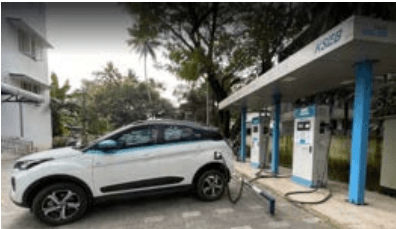
Kochi records highest number of new vehicle registrations in Kerala every year. Thus it is having a higher consumption of petroleum products as fuel for vehicles. But recently even vehicles are turning greener with the introduction of electric vehicles. Starting with Mahindra, car companies like Tesla and MG are bringing more electric vehicles to India. And Kochi is the first city in Kerala to have an electric charging station for these vehicles in Kerala. Kerala’s first electric vehicle charging station has come up at Indian Oil Corporation’s retail outlet at Edappally. Presently KSEB operates 3 EV charging stations at Kaloor, Palarivattom and Vyttila.
Kochi Municipal Corporation
ENERGY
EV charging station by KSEB in Palarivattom
446
KMRL has also envisaged a Feeder Vehicle Policy which includes all types of vehicles including 3-rickshaws/ e autos/ buses/ mini van as feeder for public carriage.
E-rickshaws during the launch of vehicles by Kochi Metro
14.4.2Solar Power
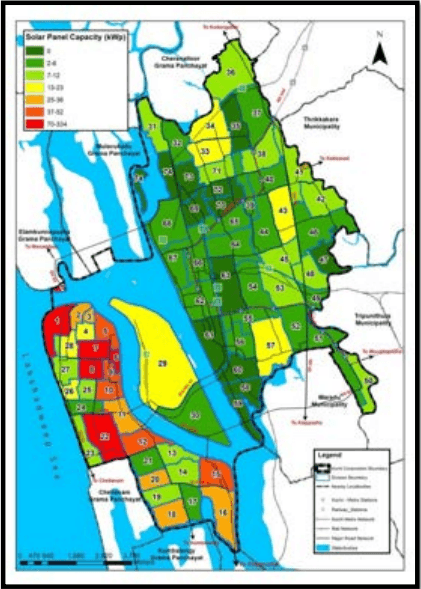
Solar energy is the main type of conventional energy used in the city. 637.75 KW of energy is fed into the main grid by both public and private sectors. Also, a few independent private initiatives which utilise solar energy, wind energy and hybrid of them to meet their energy demand are cited in the Corporation area. Solar power generation has gone up significantly in Kochi with many big firms switching over to solar energy. Kochi Metro, Cochin University of Science and Technology (CUSAT), Government Medical College, Ernakulam are some of the big institutions installing solar plants. Moreover, a majority of the 10,000 applicants who have registered with the Kerala State Electricity Board’s (KSEB) Soura roof top solar power plant projects are from Kochi. The medical college is all set to commission a 153 KW solar power plant which will cater to 10% of their power requirement. Out of 1,50,511 households, 245 use solar energy according to the data provided by ANERT in 2017-2018. This accounts for 0.16 % of total households. This number is much lesser compared with the scope for solar
Kochi Municipal Corporation
ENERGY
energy in Kochi. Figure 14:4 gives the capacity of solar panels installed in each division in Kochi Corporation under ANERT. It can be seen that more solar panels are installed in West Kochi area.
Figure 14:4 Map Showing capacity of solar panel installed in each division under ANERT Source: LSGD (Planning)
Under Köppen's climate classification, the city features a tropical monsoon climate. Surface temperatures range between 20-35 °C (68-95 °F) . The current record high temperature is 3 8 o C ; the lowest is 1 7 ° C . City has an average of 12 hours daylight throughout the year. Thus scope for solar energy is more in the city.
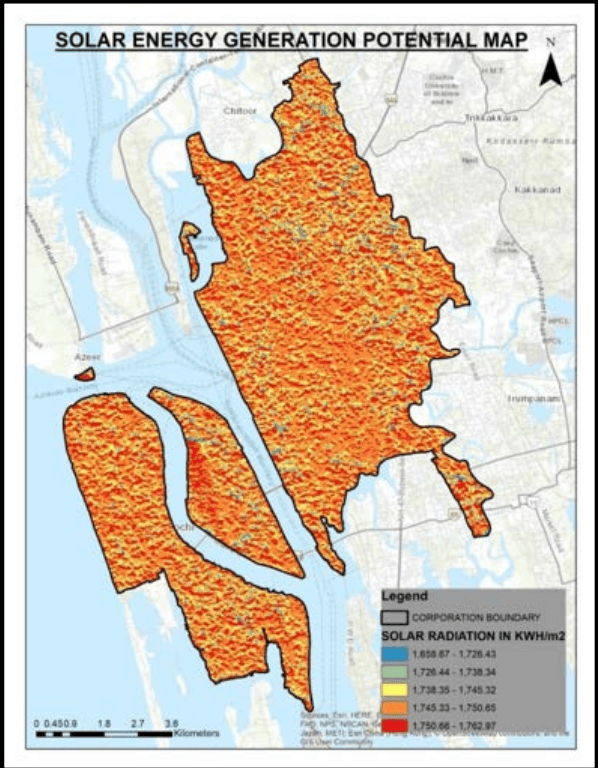
According to the solar energy generation potential map developed using A r c G I S 0 . 3 ; solar radiation inside the corporation boundary varies from 1658.67 k W h / m 2 to 1 7 6 2 . 9 7 k W h / m 2 . This clearly indicates the potential of corporation area to use solar energy as an alternative
Kochi Municipal Corporation
ENERGY
for conventional energy sources in order to produce electricity. Moreover this implies the scope of self-sufficiency of households in energy.
Figure 14:5 Solar Energy Generation potential map Source: LSGD (Planning)
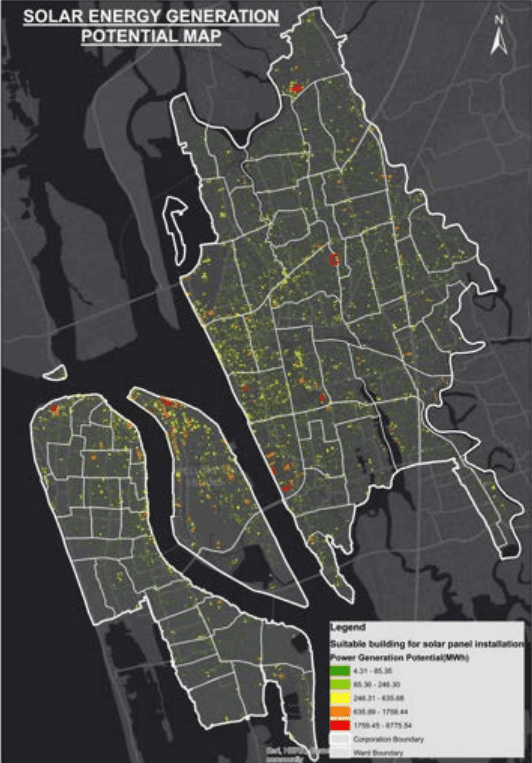
Below is the overall solar power generation potential of building roofs within the limits of Kochi corporation area generated in GIS which may be used as reference in choosing solar
Kochi Municipal Corporation
ENERGY
harvesting technologies as shown in Figure 14:6. Here the suitability of the building for solar panel installation is calculated based on building foot print, solar radiation and slope of the terrain. As per the below figure, buildings identified for solar installations are harbour building, Cochin ship yard, Central Institute of Fisheries, GCDA Building and Kaloor stadium.
Figure 14:6 Solar energy generation suitability map for buildings in Kochi Corporation Source: LSGD (Planning)
Kochi Municipal Corporation
ENERGY
On-going Schemes and Initiatives
Restructured Accelerated Power Development and Reforms Program (R-APDRP)
RAPDRP is an automation scheme by KSEB. The scheme is for implementation of IT in Power Sector and being implemented in 43 Towns each having population more than 30,000. This scheme is a part of R-APDRP Part-A scheme for 3 big towns namely Thiruvanthapuram, Ernakulum (Kochi) & Kozhikode. As part of implementation of Part-A of RAPDRP, SCADA/Distribution Management System will be implemented in the urban areas which are towns and cities with population of more than 4,00,000 and annual input energy of 350 MUs. In KSEBL, the Supervisory Control and Data Acquisition (SCADA)/Distribution Management System (DMS) project for automation of distribution systems up to 33 kV is being implemented. The cost of the project scheme is to the tune of ₹83.15 Crores. After implementation of SCADA, AMR is introduced so billing problem is solved. Revenue collection & cash realization becomes easier. Status of R-APDRP Part-B MoP (GoI) launched centrally sponsored R-APDRP (Part-B) scheme for strengthening of sub-transmission and distribution system of urban India. The total cost of this scheme is ₹1078.30 Crores. This scheme is for improvement of Distribution system by replacement of existing worn out 11 KV and LT lines, Cables and augmentation of Distribution Transformers and providing new Distribution System with the objective to reduce T&D losses below 15% in the major towns having population of more than 30,000. This scheme is being implemented in 43 towns. 40 towns work is under departmental execution and 3 towns namely Ernakulum, Kozhikode and Thiruvanthapuram. Work is under Turnkey Execution.
Integrated Power Development Scheme (IPDS)
Government of India had launched ‘Integrated Power Development Scheme’ (IPDS) in December 2014 and the scheme of R-APDRP was subsumed in this scheme as a separate component relating to IT enablement of distribution sector and strengthening of distribution network. In addition to this, IPDS has two other components, namely, strengthening of subtransmission and distribution network in the urban areas; and metering of distribution transformers/ feeders/ consumers in the urban areas. The projects under this scheme are ongoing in the city.
UDAY (Ujwal Discom Assurance Yojana)
Ministry of Power, GoI launched Ujwal DISCOM Assurance Yojana (UDAY) was approved by Union Cabinet on 2015. The scheme envisages Financial Turnaround, Operational improvement, Reduction of cost of generation of power, Development of Renewable Energy and Energy efficiency & conservation.
Kochi Municipal Corporation
ENERGY
Smart city mission, Kochi
CSML has proposed projects under smart city mission to make Kochi an Energy efficient city as shown in table 14.3. The activities proposed include implementing approved Solar City master plan recommendations, solar panels in Housing/ Institutions and Smart metering solutions.
Table 143 CSML projects
Project Name
Project Estimated Cost
Project Cost
Status
Solar panels in Govt. buildings
5.70
5.70
Project Under Implementation
Implementation of Smart LED lighting
36.00
12.50
Tender Issued
Development of Electrical Infrastructure in ABD Area
58.60
122.53
Tender Issued
Smart Poles
301.58
0.00
Tender Issued
Solar panels in public places (Canals, parks etc)
11.88
11.88
DPR to be prepared
Source: CSML, 2019
Solar city project
Kochi was one among the cities selected by MNRE (Ministry of New & Renewable Energy) to be developed as solar city under the solar cities development scheme. MNRE is responsible for all matters relating to new and renewable energy with an aim to develop and deploy new and renewable energy for supplementing the energy requirements of the country. The Solar City Project was proposed to install solar energy systems to power streetlights, garden lights, homes, hotels and restaurants, and major administrative offices in the Kochi Corporation. An amount of Rs 19.42 lakh was handed over to the Corporation by the Union Ministry of New and Renewable Energy. The Solar City Cell has also been actively conducting awareness campaigns among students and the public. As part of the move, an Energy Survey is being undertaken at Chullikal Ward as a pilot project.
Kochi-Koottanad-Bangalore-Mangalore Gas Pipeline
The pipeline is owned and operated by Gas Authority of India Limited (GAIL). The Petroleum and Natural Gas Regulatory Board (PNGRB) approved the pipeline in 2012. The project aims at connecting the southern states of Kerala, Tamil Nadu, and Karnataka to the national gas network. The pipeline would be built in two phases. The first 44-km phase would connect Kochi port to the FACT fertilizer and chemical plant in Kochi. The second 1,060-km phase would go from there to Thrissur, Koottanad and then to Coimbatore and Salem in Tamil Nadu before reaching Bangalore. The 450km pipeline stretch between Kochi and Mangalore
Kochi Municipal Corporation
ENERGY
via Koottanad was successfully completed and commissioned on 23 November, 2020 and the 439 km pipeline segment between Koottanad and Bangalore is under construction. The work on the Koottanad to Bangalore section was delayed due to the COVID-19 pandemic lockdown in the country and the construction works were resumed in April 2020. The commissioning of the Kochi - Koottanad stretch spanning 91 km would allow industries in the Mala region to tap uninterrupted supply of natural gas. Industries using LPG as feedstock could save up to Rs 85,000/ day by shifting to the cleaner CNG.
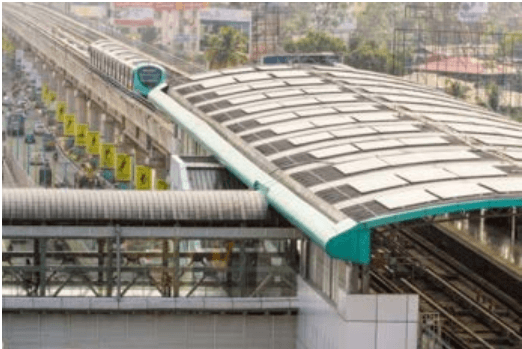
Kochi Metro – Solar Panels, Kochi
Solar panels are to be installed on roof tops of metro stations with a capacity of 4 MW using RESCO model construction with PPA of Rs 5.51 per unit for 25 years. Ground mounted solar panels at Muttom, which are grid connected with a capacity of 2.3 MW. The land area occupied is 40,000 Sq.m with a cost of 15 crore estimated.
Solar Panels over metro stations
E- Mobility Promotion Fund
452
In order to enhance clean mobility and with more people opting for electric vehicles in the wake of rising fuel prices, as per the E Mobility Promotion Fund, the Renewable Energy and Energy Savings (REES) wing of the Kerala State Electricity Board (KSEB) has decided to launch 1,140 pole-mounted charging stations across the State.
Kochi Municipal Corporation
ENERGY
Water metro- Kochi
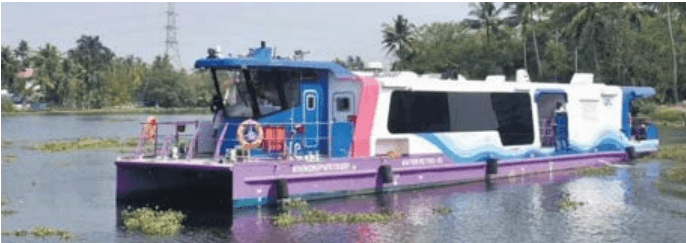
The water metro project was declared environment friendly by the state government and KFW. In order to achieve the objective it was decided that the boat would be electrically propelled and will have no outward discharge. A projected decrease 16550.05 T/ year reduction in carbon emission is estimated. 78 boats are to be purchased for the project.
Kochi Water Metro
453
Issues and Potentials
Various incentive schemes of state and central government are available to the industrial units in the city, especially seafood processing industries. However, these incentives are available only for capital expenditure and are tied with availing for loans. There are no schemes available exclusively to promote energy efficiency projects. Financial Institutions like SIDBI, Bank of Baroda, KFC, and PFC offer credit at concessional interest rate for Energy Efficiency Projects.
Issues Related To Energy Usage and Conservation and Barriers
Traditionally, small and medium scale industries in India lack the technical knowledge to identify and evaluate energy efficiency technologies and products. Typically, they also do not have internal financial resources (although the seafood processing cluster is an exception to this) and need external capital to fund EE projects. Further, they need assistance in identifying and managing technical and financial risks. Major barriers in upgradation of technology in the clusters are:
• Energy efficiency not on priority list
• Lack of awareness on energy efficiency
Lack of local service providers who can support the initiatives
Limited technical manpower
Fear of production disruption and quality issues
Kochi Municipal Corporation
ENERGY
Energy availability
The power supplies to the clusters are by KSEB, through LT and/ or HT connections. Reliable and quality power has been a concern in the cluster. Power cuts are imposed, mainly in peak season such as the summer. Most of the units have back up power in the form of emergency DG Sets to have incessant working.
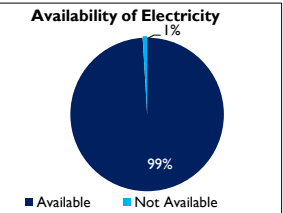
Total number of connection is almost double the household size which implies 100% electrification in the city limits. But quality of electricity still remains a problem in few areas which needs to be addressed. Power cuts and voltage issues occur only on time of natural disasters. Use of conventional sources like solar energy is very less compared to scope and potential for the same. Kochi City, having been identified as the solar city by MNRE holds immense possibilities for the production of solar energy in future. But the issue with the long term storage of energy also needs to be addressed. City is occupied with adequate number of innovative and efficient schemes for an eco-friendly and efficient future in this sector
Kochi Municipal Corporation
15.1
Introduction
EDUCATION
14.2.2Connections and Consumption
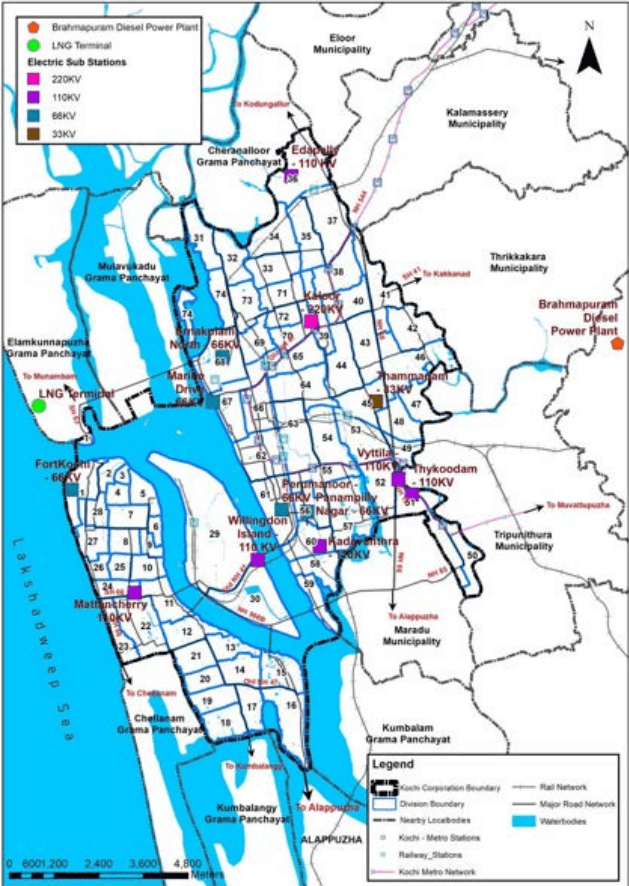
The Corporation area has 2.52 lakh power connections. There are 13 Substations within Kochi Corporation area under Kalamassery Transmission Circle. There is a 220 kV Substation at Kaloor followed by six 110 kV substations, five 66 kV sub stations and one 33 kV substation at Thammanam. They are spatially represented in figure
According to URDPFI guidelines; the provision of one electric substation of 11 KV for a population of 15,000 is considered as general standard for electricity distribution. As per the above calculation, 55 Nos - 11 kV sub stations are needed for the horizon year. Considering the present number of stations as shown in Table 14:1 , it can be seen that this meets the demand for the horizon year.
Table 141 Projection for Electrical Distribution requirements in Kochi Corporation area
Existing (2021)
2041
Gap
Sub-stations: One 11 kV sub-station for every 15000 population
1 - 33 kV 5 - 66 kV 6 -110 kV 1 - 220 kV
55 -11 Kv/ 6-110 Kv
Meeting the demand
Source : LSGD (Planning)
Kochi Municipal Corporation
ENERGY
Figure 14:1 Map showing locations of Electric Substations Source: LSGD (Planning)
Kochi Municipal Corporation
ENERGY
Sector wise break up of number of connections is given in Table 14:2. There are a total of 252302 connections with an energy consumption of 113.84 MKWH.
Table 142 Category Wise Break Up of No. of Electricity Connections and Consumption
Type
Category wise Break up
Total
Residential
Commercial
Industrial
Agricultural
Other
Number of Electric Connections
187224
62411
2399
171
97
252302
Electric Consumption (MKWH)
65.74
38.19
4.49
0.02
5.40
113.84
Source: KSEB Electric Circle, Ernakulam
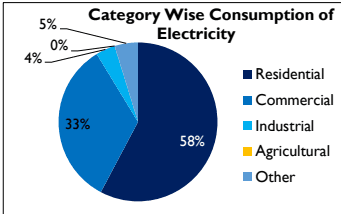
The sector wise consumption of electricity is shown below. From the figure, it is clear that about 58% of the total consumption accounts from domestic connections and 33 % accounts from commercial connections. The consumption by agricultural sector is negligible when the proportion is considered. Connections under agricultural sub-section include connection given for the working of pump houses for irrigation purpose and also connections given to poultry farms, cattle farms etc.
444
Figure 14:2 Category Wise Consumption of Electricity and availability of Electricity in Corporation area Source: KSEB, Census 2011, smartcities.gov.in
Based on the estimated requirements of power supply as per the National Electricity Policy published in 2005, the recommended consumption is 1000 units per Capita per year or 2.74
Kochi Municipal Corporation
ENERGY
kWh per capita per day demand which includes domestic, commercial, industrial and other requirements. As per the consumption statistic, this demand is satisfied.
Conventional Sources
The main petroleum products are diesel, Kerosene, naphtha, aviation fuel, furnace oil, LPG etc.
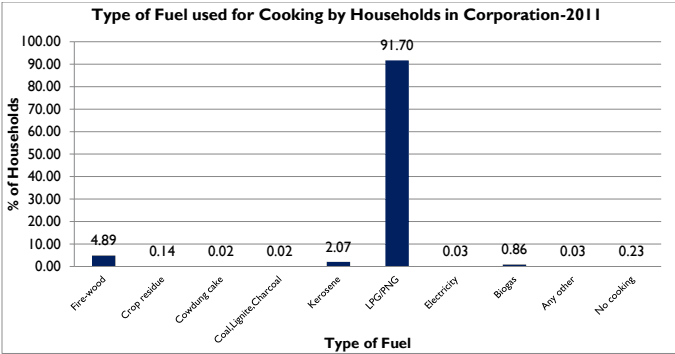
Under the domestic use; as per census 2011, the major type of fuel used for cooking by households in Corporation area is LPG/PNG (91.7%) followed by low Proportion of firewood (4.89%) and Kerosene (2.07%). Use of Electricity and Biogas as a source of cooking fuel is very low in the Corporation area.
Figure 14:3 Fuel used for Cooking in Kochi Municipal Corporation Source: Census 2011