Over the past few years, several National policies have evolved in India that orient the perspectives of shaping built environments and services towards greater accessibility for all.
1.3.1 Rights for Persons with Disabilities Act, 2016
Rights of Persons with Disabilities Act, 2016 is a landmark act which reinforces the idea of equity and non discrimination for persons with disabilities in it’s various sections. Not only does it endorse accessibility as an essential requirement for all built environments and in all walks of life, it also clearly advocates the idea of non discrimination in all services rendered both by public and private sectors in diverse domains. This implies accessibility as a mandatory provision in all building typologies including housing, education, mobility or transportation, health, work or employment, recreation and any other domain of built forms not listed above.
The RPWD Act, 201622 specifies twenty one types of disabilities within the ambit of the law and also introduces a category
of ‘persons with benchmark disabilities’ beyond the specified disabilities. The specified disabilities include
-
Physical Disability a.Leprosy cured persons b.Cerebral Palsy c. Dwarfism d.Muscular Dystrophy e.Acid attack victims
-
Visual Impairment a.Blindness b.Low vision
-
Hearing Impairment a.Deaf b.Hard of Hearing
-
Speech and Language disability
-
Intellectual Disability a.Specific learning disabilities b.Autism spectrum disorder
-
Mental Behaviour a.Mental illness
-
Disability caused due to a.Chronic neurological conditions viz. (i) Multiple sclerosis (ii )Parkinson’s disease b.Blood disorder viz. (i) Haemophilia (ii) Thalassemia (iii) Sickle cell disease
-
Multiple Disabilities (more than one of the above specified disabilities) including deaf blindness.
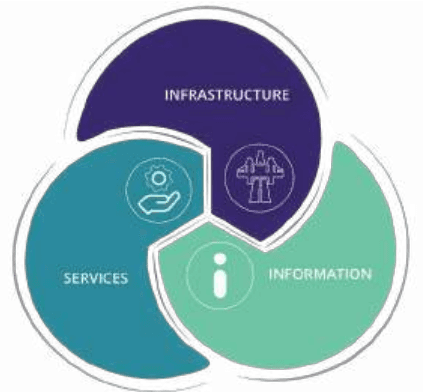
In adherence to the above Act and responsiveness to an inclusive urban future, it is vital to progressively work towards accessible infrastructures in
Chapter1: Introduction

SUSTAINABLE DEVELOPMENT GOALS

CONVENTION ON THE RIGHTS OF PERSONS WITH DISABILITIES
REGISTERED NO. DL-(N04B007/2003-16
HT The Gazette of India
相EXTRAORDINARY PART II—Section 1 wifven è yerfire PUBLISHED BY AUTHORITY
59] fee, y fet 28, 2016/ 07, 1938 (ww) No. 99] NEW DELHL WEDNESDAY, DECEMBER 28, 2016/PAUSHA 07, 1938 (SAKA)
Separate paging is given to thás Part in order that ia may be fied as a separate cumpilatian
MINISTRY OFLAWAND JUSTICE (Legislative Department)
27th December, 2016, and is hereby published for general information:-
THERIGHTS OFPERSONS WITH DISABILITIESACT,2016

Figure 1.2 National and International Policy Perspectives
Accessible India-Empowered India
Accessible India Campaign
built environments Provisions under this act not only highlight their relevance but also make it mandatory for built environments to make them accessible.
Chapter VIII of the RPWD Act clearly highlights the idea of non discrimination in built environments.
A brief reiteration of Section 40 and 44 from the RPWD, 2016 is stated below to highlight the focus on accessibility through Harmonised guidelines. It also highlights the accessibility perspectives as per the law. Besides that, it mentions the other relevant Sections 41, 42 and 43.
Section 40 Accessibility
The Central Government shall, in consultation with the Chief Commissioner, formulate rules for persons with disabilities laying down the standards of accessibility for the physical environment, transportation, information and communications, including appropriate technologies and systems, and other facilities and services provided to the public in urban and rural areas.
Section 41 Access to Transport
Section 42 Access to information and communication technology