River Systems of PMR
All rivers in PMR mostly originate from the western part of the Sahyadri Hills and flow through the eastern part of the district.
The Pune Metropolitan Region has three major river systems, namely:
-
The Bhima-Ghod River system in the northern, north-eastern and eastern part
-
Mula-Mutha River system covering the central part
-
Small part of the Nira River system covering the south part
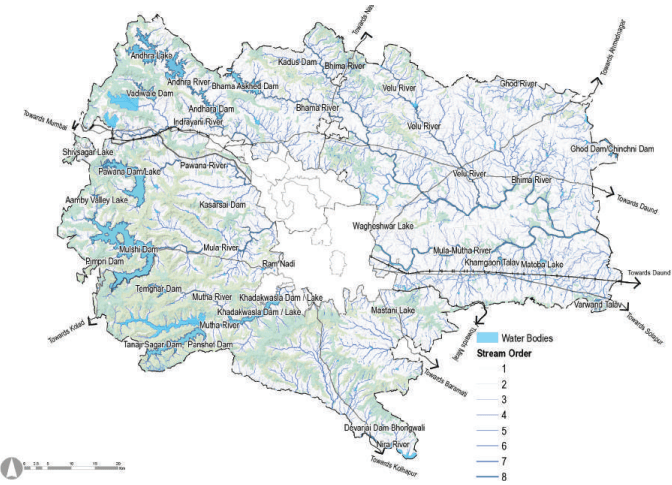
Major rivers originating in the region include Bhima, Bhama, Pavana, Indrayani, Mula, Mutha and Nira, all tributaries of Bhima. These rivers originate in the Sahyadri region on the western side and have minimum travel length. Most of the reservoirs are located on the western side of the region wherein the annual rainfall is both higher and assured. Based on geomorphological settings and drainage patterns, the district is divided into 33 watersheds.
Figure 2.7 shows major rivers passing through PMR, the river basin boundaries and the drainage catchments.
Chapter 2: Physical Features and Environment
Figure 2.7: Pune: Rivers and Watersheds
Source: Central Water and Power Research Station, Pune; Water Resources Department, GoM.
Ponds and Lakes
Based on the ELU database, presently the region has numerous ponds spread across the Study Area. Surface areas of these ponds vary drastically. Further, there are xx lakes (other than irrigation projects) covering xx sq km of area. Majority of these lakes are in Mawal taluka.
For analysis purposes, criteria of funding assistance for rainwater harvesting structure as per Rashtriya Krishi Vikas Yojana is referred (average size of farm pond 20mx20mx3m, community pond 100mx100mx3m). Based on these selection criteria, there are 9,967 existing ponds (≥400 m2) and 240 ponds (≥ 10,000 m2) as per the ELU database.
Ground Water
95% of the area in Pune district is underlain with hard rock (Basalt) formation. The rocks give rise to a complex and extensive low-storage aquifer system where the water level tends to drop rapidly once the water table falls by more than 2 m to 6 m. Additionally, these aquifers also have low permeability which limits their recharge through rainfall. This means water in these aquifers is non-replenishable and will eventually dry out due to continuous usage/drawdown. The overall groundwater development of Pune district is 71.51%. However, within PMR, Purandar taluka is categorised as semi-critical. The rest of the talukas in PMR are classified as safe for further water development.