Vision 2041 “india’s Most Livable Habitat”
Globally, the assets mentioned above are considered as basic parameters to define the livability of a place. Considering the increasing stress on urban livability, the Study Area shall proactively harness these assets to become India’s most Livable Metropolitan Habitat (Metropolitan Region). It shall ensure livability by implementing five Goals as illustrated subsequently in this chapter.
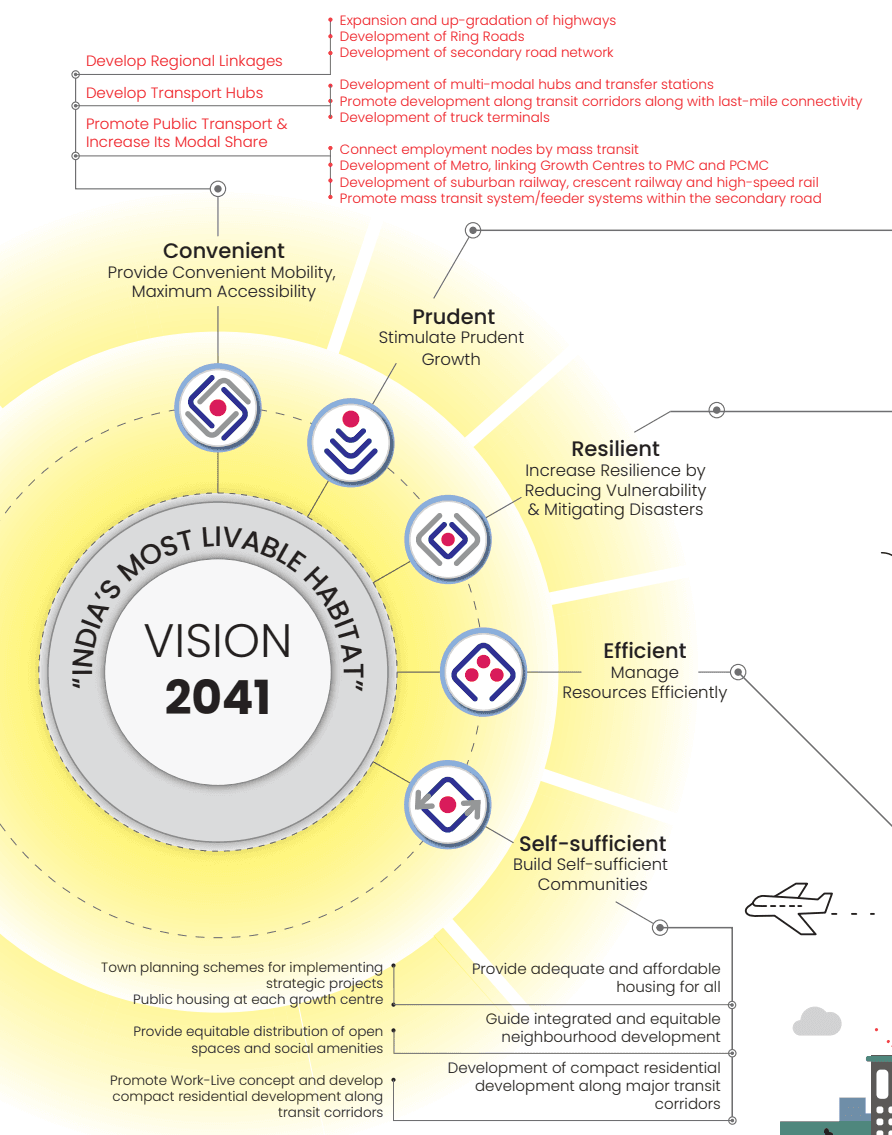
Consolidate employment nodes for vibrant economic centres Promote integrated commercial development at major transit hubs enabling transit services to regional job centres, job creation and investments in transit serviced locations Development of tourism nodes
Promote Consolidated Employment Centres
Promote Industrial and Logistics Clusters
Promote Innovation Hubs
Conserving Green Ribbon
Protecting Green Segments
Preserving Green Canvas
Promote synergies for Industry 4.0 ( Next Generation Industry) through expansion of industrial development along with technological advancement Consolidate development of logistics clusters along Crescent railway and radial roads Provide logistic hubs as urban-rural nexus
Create a vibrant startups ecosystem Add value to existing agro-supply chain through agro-processing/R&D hubs Promote biotechnology and pharmaceuticals hubs Promote educational hubs focusing on STEM, R&D and skilled development Empower Rural Development
Protect and conserve all water bodies: streams, rivers, canals, ponds, lakes and reservoirs
Reduce vulnerability by demarcating flood lines (blue lines) and safeguarding through green belt
Demarcate flood lines and augment flood control measures Develop avenues conceived as a tree-lined road, with Non Motorised Transport (NMT) provision, linking the Green and Blue features
Protect and Conserve Western Ghats (eco sensitive zone) and forests Controlled development in eco-sensitive zones, establishing contiguity of forest and development of regional parks Protect Hilltop & hill slopes Develop parks as green lungs within Growth Centres Promote plantation of indigenous trees within Catchment areas and along bottom of the hills
Develop efficient networks for piped water supply and sewage in each Growth Centre
Promote water conservation and recycling
Promote circular economy through waste management
Develop trunk infrastructre for water supply and sewage network for each Growth Centre
Encourage share of renewable energy within the grid
Promote recycling of wastewater at each Urban Centre Recharge groundwater through rainwater harvesting
Promote Carbon Neutral Townships Promote renewable energy banks within urban and rural centres
Decentralisation of solid waste management sites Promote the in-situ solutions to recycling of organic waste Mandate industrial waste recycling and effluent treatment
Encourage an increase in renewables share Facilitate waste to energy concept
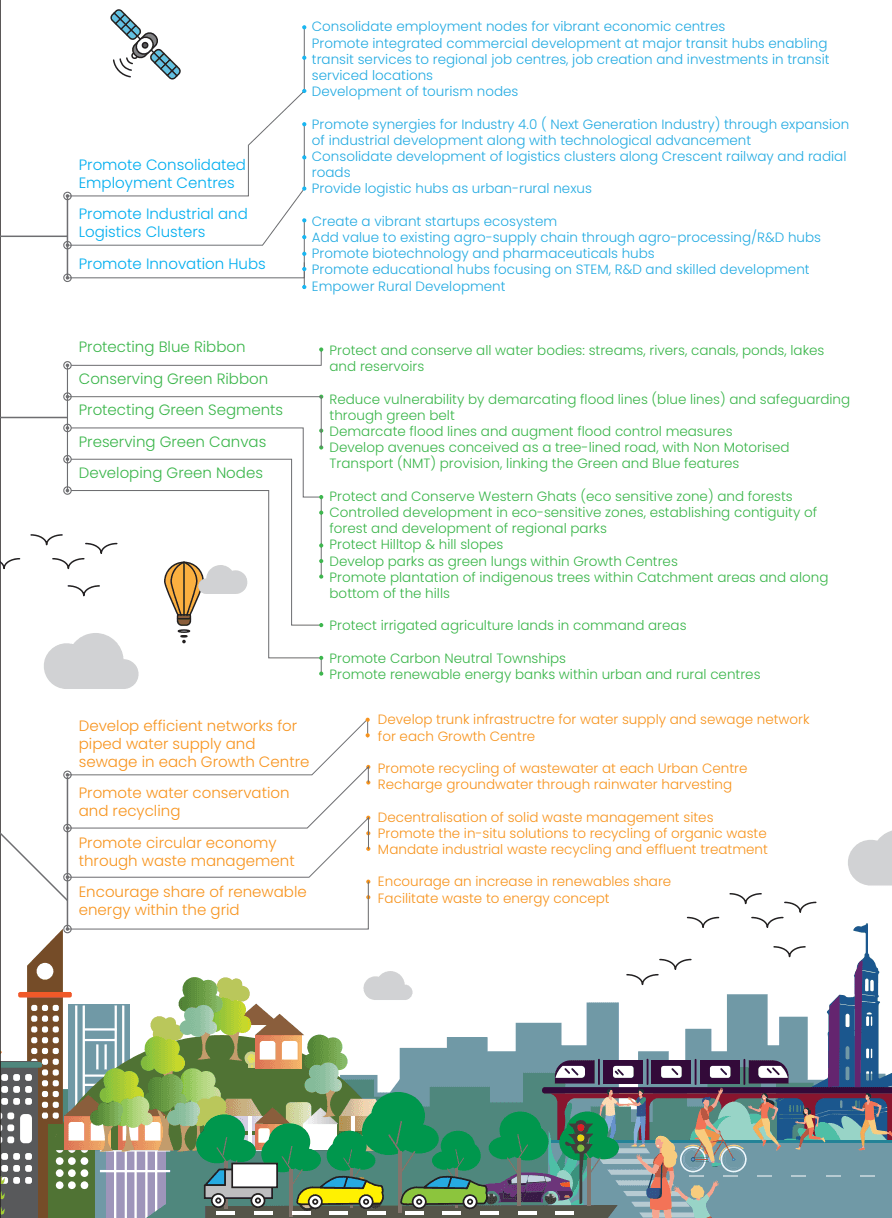
Protect irrigated agriculture lands in command areas
Goals, Objectives and Actions
Goal 1 - Convenient: Provide Convenient Mobility, Maximum Accessibility
The convenient goal aims to facilitate complete ease of access to transit facilities, thereby inducing people to use public transportation over the private mode of transport and prefer to walk. In order to achieve the ‘Convenient’ goal, the following strategies and actions are proposed:
| Objective | Actions |
| Develop Regional Linkages | Action 1: Expansion and up-gradation of highways |
| Action 2: Development of Ring Roads | |
| Action 3: Development of secondary road network | |
| Develop Transport Hubs | Action 4: Development of multi-modal hubs and transfer stations |
| Action 5: Promote development along transit corridors along with last-mile connectivity | |
| Action 6: Development of truck terminals | |
| Promote Public Transport and Increase Its Modal Share | Action 7: Connect employment nodes by mass transit |
| Action 8: Development of Metro, linking Growth Centres to PMC and PCMC | |
| Action 9: Development of suburban railway, crescent railway and high-speed rail | |
| Action 10: Promote mass transit system/feeder systems within the secondary road |
Goal 2 - Prudent: Stimlate Prudent Growth
The prudent goal aims at delivering a stimulus to the economy and employment through following strategies and actions:
| Objectives | Actions |
|---|---|
| Promote Consolidated Employment Centres | Action 1: Consolidate employment nodes for vibrant economic centres Action 2: Promote integrated commercial development at major transit hubs enabling transit services to regional job centres, job creation and investments in transit serviced locations Action 3: Development of tourism nodes |
| Promote Industrial and | Action 4: Promote synergies for Industry 4.0 ( Next Generation Industry) through expansion of industrial development along with technological advancement Action 5: Consolidate development of logistics clusters along Crescent railway and |
| Logistics Clusters | radial roads Action 6: Provide logistic hubs as urban-rural nexus |
| Promote Innovation Hubs | Action 7: Create a vibrant startups ecosystem Action 8: Add value to existing agro-supply chain through agro-processing/R&D hubs Action 9: Promote biotechnology and pharmaceuticals hubs Action 10: Promote educational hubs focusing on STEM, R&D and skilled development Action 11: Empower Rural Development |
Chapter 12: Vision Framework
Goal 3 - Resilient: Increase Resilience by Reducing Vulnerability and Mitigating Disasters
The resilient goal aims to mitigate disasters through appropriate measures, which would help reduce the vulnerability of PMR to both natural and human-made disasters. In order to achieve the ‘Resilient’ goal, the following strategies and actions are proposed:
| Objectives | Actions |
|---|---|
| Protecting Blue Ribbon | Action 1: Protect and conserve all water bodies: streams, rivers, canals, ponds, lakes and reservoirs |
| Conserving Green Ribbon | Action 2: Reduce vulnerability by demarcating flood lines (blue lines) and safeguarding through green belt Action 3: Demarcate flood lines and augment flood control measures Action 4: Develop avenues conceived as a tree-lined road, with Non Motorised Transport (NMT) provision, linking the Green and Blue features |
| Protecting Green Segments | Action 5: Protect and Conserve Western Ghats (eco sensitive zone) and forests Action 6: Controlled development in eco-sensitive zones, establishing contiguity of forest and development of regional parks Action 7: Protect Hilltop & hill slopes Action 8: Develop parks as green lungs within Growth Centres Action 9: Promote plantation of indigenous trees within Catchment areas and along bottom of the hills |
| Preserving Green Canvas | Action 10: Protect irrigated agriculture lands in command areas |
| Developing Green | Action 11: Promote Carbon Neutral Townships |
| Nodes | Action 12: Promote renewable energy banks within urban and rural centres |
Goal 4 - Efficient: Manage Resources Efficiently
The efficient goal aims to ensure availability and sustainable water and sanitation management through improved physical infrastructure and balanced distribution of natural resources. In order to achieve the ‘Efficient’ goal, the following strategies and actions are proposed:
| Objectives | Actions |
| Develop efficient systems for water supply and sewage in each Growth Centre | Action 1: Develop trunk infrastructure for water supply and sewage network for each Growth Centre |
| Promote water conservation and recycling | Action 2: Promote recycling of wastewater at each Urban Centre |
| Action 3: Recharge groundwater through rainwater harvesting | |
| Promote circular economy through waste management | Action 4: Decentralisation of solid waste management sites |
| Action 5: Promote the in-situ solutions to recycling of organic waste | |
| Action 6: Mandate industrial waste recycling and effluent treatment | |
| Encourage share of renewable energy within the grid | Action 7: Encourage an increase in renewables share |
| Action 8: Facilitate waste to energy concept |
Goal 5 - Self-sufficient: Build Self-sufficient Communities
The self-sufficient goal aims at inclusive and equitable distribution of amenities, ensuring healthy lives and promoting well-being for all. In order to achieve the ‘Self Sufficient’ goal, the following strategies and actions are proposed:
| Objectives | Actions |
|---|---|
| Provide adequate and | Action 1: Town planning schemes for implementing strategic projects |
| affordable housing for all | Action 2: Public housing at each growth centre |
| Guide integrated and | |
| equitable neighbourhood | Action 3: Provide equitable distribution of open spaces and social amenities |
| development | |
| Development of compact | |
| residential development | Action 4: Promote Work-Live concept and develop compact residential development |
| along major transit | along transit corridors |
| corridors |
In summary, the vision and its implementation strategy are detailed in the above structure incorporating 45 actions. The livability of the region would largely depend on the successful implementation of the strategies stated above and corresponding representative actions.