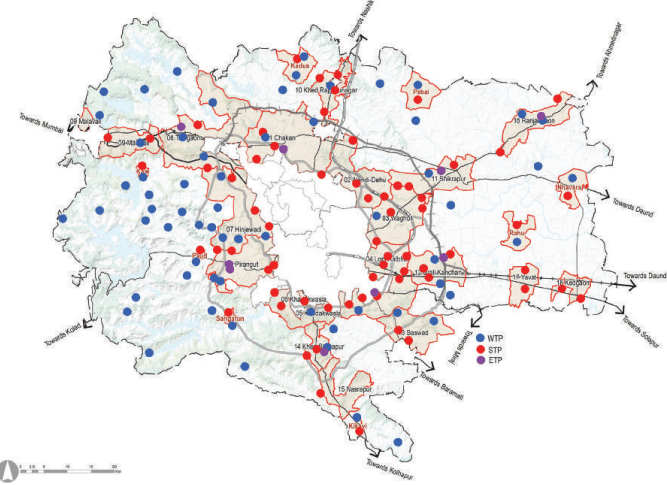
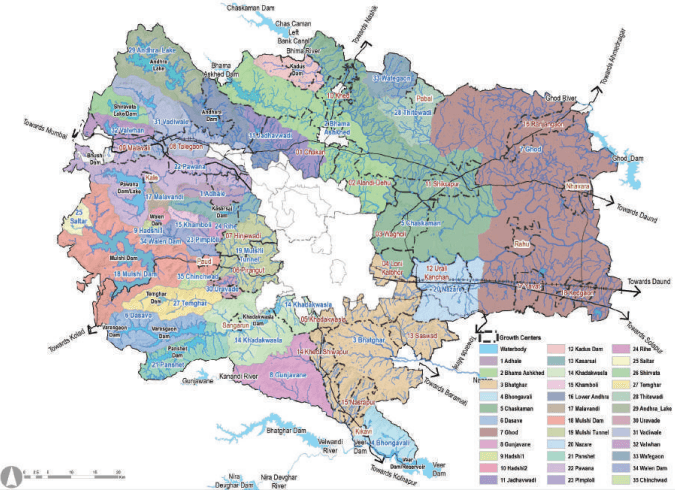
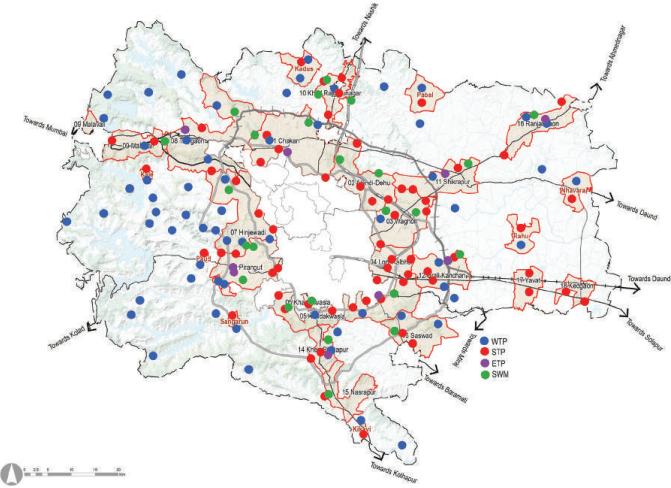
Water Conservation Strategy:
Balancing reservoirs: Quarry areas hold the opportunity for developing some of the non-functional quarries into water reservoirs. Due to the quarrying activity for extracting stones and other construction materials, natural water containers are formed. These containers are lined by impermeable surface, providing a good opportunity for developing them as balancing reservoirs. These cases would be implemented, after detailed study of its feasibility, within existing quarries in Chakan, Alandi and Wagholi Growth Centres, by lifting water from the Indrayani River and refilling these reservoirs. Some of these reservoirs are at higher elevation, water could be drawn through gravitational force.
Augmentation of existing sources: The existing M.I. tanks are based on the FRL received from the State Water Resources Department. Periodic desilting of the tank would be required. However, in case the water requirement increases, water holding capacity of certain M.I tanks, after detailed study, could be increased by raising the height of Waist Weir Bar. In order to provide for the raise in height, provision is made by proposing green belt skirting the M.I. tanks.
Developing barrages: Certain rivers like Bhima, where excess water is available, barrages could be developed across certain cross-sections of the river. This would aid in arresting and utilising the excess water as an alternative water source. It could only be done in concurrence with the State Water Resources Department, also by aligning with the Interstate Water Distribute Tribunals.
Preservation of Shivkalin lakes: PMR has a rich heritage and certain lakes are part of it. Few ‘Shivkalin’ lakes are observed in PMR, specially in Daund Taluka. It is proposed that these lakes could be re-utilised and maintained further by lifting water from near-by water sources and filling these lakes. These would act as additional water sources for the local villages surrounding the lakes.
Rainwater harvesting: As per U-DCPR, rainwater harvesting is promoted with incentives for newer developments. However, rainwater harvesting could also be taken up by individual Grampanchayat, creating a local water source for the village, making it self sufficient. This could be readily done in the Western Ghat villages, where rainfall is heavy and high water-run off. These percolation tanks could be proposed within the proposed afforestation zone at foothills.
Catchment Treatment Plan/ Increase in Ground-water: Ground water table within PMR is depleting rapidly. In order to increase the percolation of rainwater and augment the ground-water table, Catchment Treatment Plan (CTP) could be proposed. It involves certain majors such as creating bunds across nalas, trenching, constriction of Gabion walls, dense plantation of indigenous trees along slope, reducing the downhill water force, could be proposed. Deepening and widening of streams, construction of earthen stop dams and digging of farm ponds are few other steps which could be further taken up.
Storm-water Management Plan: The urbanised areas in PMR are facing serious issues of stormwater and surface runoff management due to diversion of the natural runoff pattern, encroachment on the natural streams, and inefficient surface runoff management. The issue of flooding in some parts of the rural areas is observed in the region on the southern and northern side. The effective runoff management, defining the correct runoff intensity and runoff management with rain water harvesting mechanism could overcome the present situation. It is thus recommended that a Storm Water Management Plan could be prepared considering effective guidelines of CPHEEO, GIS analysis and Sewer GEMS.