Solid Waste Management (SWM) is an obligatory function of the BBMP and is governed by the Solid Waste Management Rules, 2016 (“SWM Rules”) and several court directives. In BMA, which comprises of BBMP and around 50 Gram Panchayats, there is no single unified authority for the waste management. BBMP is looking after the waste management within its jurisdiction, while the rest of the area, which is administered by different Gram Panchayath’s, concerned Gram Panchayath is responsible for waste management in their respective jurisdictions.
BBMP is in the midst of transforming its waste management system from centralised to a decentralised one. Going forward with the decentralized approach, in BBMP area, SWM facilities have been substantially provisioned at the ward, zone and city level. BBMP looks after the collection, transportation, segregation, processing, treatment and disposal of solid waste in the city of Bengaluru. BBMP has established dry waste collection centres, enhanced solid waste collection and transportation activity, mechanical sweeping, bulk waste management and waste processing units using modern technologies like bio-methanation waste to energy plants and vermi-composting facilities.
Essentially, BBMP is aiming at The Integrated Solid Waste Management (ISWM) System – a waste management hierarchy (refer Figure 12-1), to ensure reduction in the amount of waste being disposed (Landfill waste) and maximise resource recovery and efficiency.
Figure 12-1: Integrated Solid Waste Management System Hierarchy
| Most Preferred | |
| At Source Reduction & Reuse | Waste minimisation and sustainable use/multi use of products (e.g. reuse of carry bags/packaging jars) |
| Recycling | Processing non-biodegradable waste to recover commercially valuable materials (e.g. plastic, paper, metal, glass, e-Waste recycling) |
| Composting | Processing organic waste to recover compost (e.g. windrow composting, in-vessel composting, vermi composting) |
| Waste to Energy | Recovering energy before final disposal of waste (e.g. RDF, biomethanation, co-processing of combustible non-biodegradable dry fraction of MSW, incineration) |
| Landfills | Safe disposal of inert residual waste at sanitary landfills |
In Panchayath areas within BMA, reliable information about the management of waste is not readly available. However, the comprehensive socio-economic household survey suggests that 14% of the households in these villages have access to waste collection system. Hence, the existing Status on Solid Waste is limited to BBMP. However, forecasts and demand estimates are for the entire BMA
(including part of BMICAPA). In view of the above, to attain a sustainable solid waste management system in Bengaluru, BBMP has adopted the following Approach and Strategies within its jurisdiction.
a) The Approach:
Reduce – Reuse – Recycle (3R approach): The 3R Approach is aimed at optimising SWM management from all the waste-generating sectors and involving all the stakeholders (waste generators, service providers, informal sector, regulators, government, and community or neighbourhoods). The adoption of 3R minimizes the waste being handled by the local bodies (BBMP/GPs), minimizing public health and environment risk associated with it.
b) Strategies:
Decentralised SWM Systems: In order to reduce the burden of unscientific handling of large volumes of MSW, the city has opted to shift its focus from a centralised ‘single stream’ collection and ‘Landfill disposal’ system to a decentralised ‘multiple stream’ collection and scientific ‘Processing’ system.
Separating Bulk Generators: Bulk Generators contribute to 25% of the city’s waste and have been separated from the regular collection cycle. They include domestic generators - apartment complexes with more than 50 units and Commercial bulk generators viz. hotel/ restaurant, clubs, factory, choultry, mall, shopping complex, marriage halls, convention hall, place of worship, institution, office establishment, railway stations, bus stand or any other commercial or public entity which accumulates MSW of a quantity not less than 10 kg per day. These generators are being mandated to set up in-situ systems or link with BBMP empanelled vendors to manage their waste.
Micro plan: A Micro Plan is a process of creating a solid waste management plan for the smallest unit of management, by splitting the ward into blocks (750 Households + shops). City-wide implementation of the micro SWM plan is already being rolled out in the BBMP area.
The master plan proposes that similar approach and strategies be followed by respective Gram Panchayats in consultation with various stakeholders including ward committees and SWM experts within LPA of BDA for better synchronisation synergies and optimisation of resources. With this background, the RMP 2031 has analysed the existing status of SWM within BMA and has formulated the proposals for allocation of land for SWM facilities in consultation with BBMP.
12.2.1 Municipal Solid Waste Generation
As per the assessment and quantification of municipal solid waste generation carried out by BBMP in the year 2016, the waste generation rate in BBMP area is approximately 564 grams/capita/day (gcpd). In addition, the villages administered by the Gram Panchayath’s are expected to get further urbanised/ populated by 2031 with planned development as envisaged by RMP-2031 and therefore, similar estimates have been made for areas outside BBMP.
AUTHORITY ★
RMP 2031 has considered waste generation growth rate at 1.3% per annum on the base of 564 gcpd to estimate per capita waste generation by 2031. RMP 2031 estimates that about 13911 tonnes per day of Municipal Solid Waste (MSW) will be generated in BMA by the year 2031 (Table 12-1).
| Year | MSW gpcd@1.3%growth p.a. | BBMP Area (8 zones; 198 wards) | Outside BBMP Area (50 Gram Panchayath's; 251 Villages) | BMA (BBMP area + Villages) | |||
| Projected Population | MSW generation (TPD) | Projected Population | MSW generation (TPD) | Projected Population | MSW generation (TPD) | ||
| 2016 | 564 | 10207062 | 5757 | 844837 | 476 | 11051899 | 6233 |
| 2021E | 602 | 12164520 | 7318 | 1386925 | 834 | 13551445 | 8153 |
| 2026E | 642 | 14026694 | 9002 | 2590119 | 1662 | 16616813 | 10664 |
| 2031E | 685 | 15480378 | 10597 | 4840427 | 3314 | 20320805 | 13911 |
Source: BBMP
-gpcd: gram per capita per day (as per 2016 waste assessment carried out by BBMP)
-gpcd for BMA is calculated as per gpcd considered for BBMP area
-TPD: Tonnes per day
-Municipal Solid Waste (MSW) comprises of: Residential HH; Small commercial establishments, Bulk generators; Street Sweeping
-MSW excludes Construction & Demolition Waste [estimated to be around 1500 to 2000 TPD (2016 assessment) E-estimates
12.2.2 Waste Streams & Composition – BMA
In line with the SWM Rules 2016 and micro assessment carried out by BBMP, the 4 basic streams of waste identified are as follows. Subsequently, the waste composition for BMA (assuming same for outside BBMP area) is depicted in Figure 12-2.
Wet Waste: Any organic material that can be degraded by micro-organisms into simpler stable compounds. It includes household kitchen waste, food waste from small hotels and bakeries and garden waste.
Dry Waste: Waste other than food waste and inert and includes recyclable waste, non-recyclable waste, combustible waste and sanitary waste
Domestic Hazardous Waste: comprises sanitary and bio-medical waste. This includes hygiene products like sanitary napkins and baby or adult diapers contaminated with blood, urine and faeces; and bandages and sharp objects like syringes and needles
Inert/Reject Waste: includes street sweeping inert (like silt from drains) and post processing rejects from the wet waste processing units or dry waste collection centres. It does not refer to mixed waste or construction and debris waste.
In addition, other waste streams that are being addressed in terms of segregating, collecting and processing are:
• Coconut Waste: This includes the exterior shell of tender coconut left over after the water is consumed
Leaf/Garden Waste: This is all horticulture waste and includes leaf litter, garden pruning, and branch cuttings.
Figure 12-2: Waste Composition - BMA
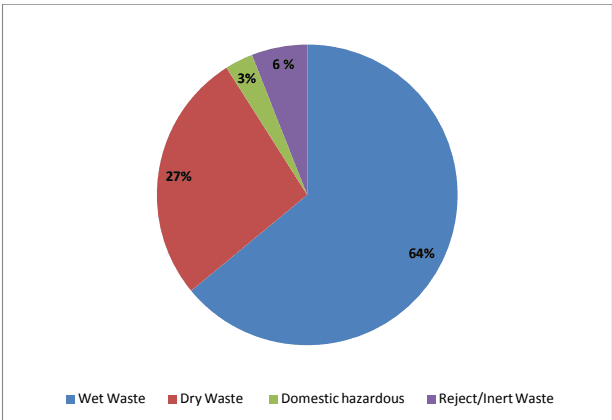
The waste composition is the basis of projections-stream wise projections for entire BMA. Table 12-2 provides the estimated quantum of wet, dry, domestic hazardous and reject waste generation in the year 2031.
| Waste Streams | Waste Composition | Quantum of Waste Generated (TPD) |
|---|---|---|
| Wet Waste | 64% | 8903 |
| Dry Waste | 27% | 3756 |
| Domestic Hazardous Waste | 3% | 417 |
| Rejects/Inert waste | 6% | 835 |
| Total | 100% | 13911 |
12.2.3 Waste Segregation, Collection & Transportation
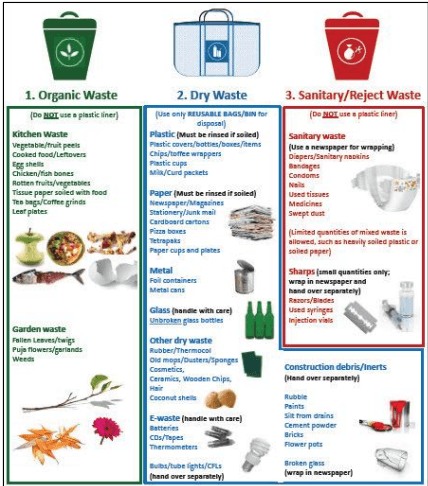
As per the High court directive dated 17 December 2015, 3-way segregation at source (wet, domestic hazardous & dry) for domestic generators and 2-way segregation for commercial generators was mandated and is being implemented.
AUTHORITY ★
Figure 12-3: Waste Segregation Guidelines
Source: BBMP
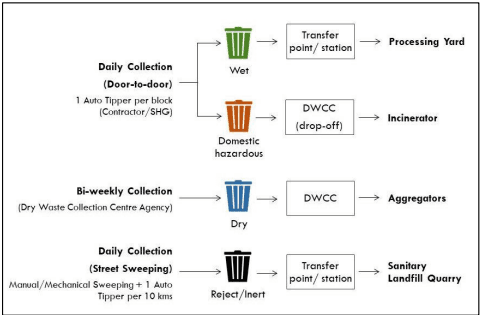
Primary collection & transportation involves three activities - wet and domestic hazardous waste collection (daily), dry waste collection (bi-weekly) and street sweeping (frequency based on road width)
Figure 12-4: Waste Collection & Transportation Process
★
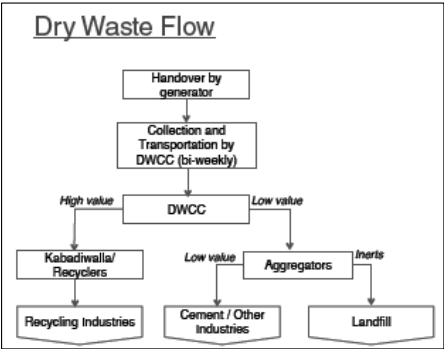
Dry Waste: For recycling of Dry waste in the city, at present there are 196 Dry Waste Collection Centers (DWCC), 1 per ward and large aggregators as per zonal requirement. Out of 27% of dry waste generated in the city, only 36% of it is currently processed. Figure 12-5 presents the Dry waste flow.
Figure 12-5: Dry Waste Flow
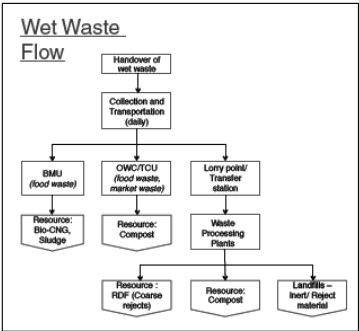
Wet Waste: For city level processing of wet waste, at present there are 11 bio-methanation units (BMU), 7 organic waste converters (OWC) as per ward requirement – small hotels and markets and windrow composting in 9 integrated waste processing plants (IWPP) at the zone level. At present, out of 64% of the total wet waste generated in the city 92.5% is processed in IWPP, 7% in BMU and 0.25% in OWC’s.
Figure 12-6: Wet Waste Flow
BANGALOE AUTHORITY ★
Domestic Hazardous Waste: At present, out of 3% of the total domestic hazardous waste generated in the city, only 1% of the waste is processed by existing biomedical waste processing agencies.
Inert/Reject Waste: At present, 6% of the total waste generated in the city is inert waste, meaning waste that cannot be further processed or utilized in any other form. This waste is usually termed as Landfill waste as it is disposed of in a sanitary landfill.
12.2.4 Waste Disposal
Although Inert waste comprise 6% of the total waste generated at present and the waste to be landfilled should be approx. 10-12% of the total waste however, taking into account post-processing rejects from the wet waste processing units or dry waste collection centres including unprocessed dry waste (~17%) along with construction and debris waste altogether, make up to over 25-30% of the waste going to Landfill.
(a) Processing of Domestic Hazardous Waste generated:
The segregated domestic hazardous Waste (including sanitary waste) will be collected from drop-off locations/points (DWCCs) and further processed by existing biomedical waste processing agencies. The facilities include incinerators, Autoclaves, Shredders and Effluent Treatment Plants to scientifically dispose this waste. There are 3 units to manage bio-medical waste in Bengaluru: 1) SembRamky Environmental Management Pvt. Ltd. 2) Maridi Eco Industries Pvt. Ltd. 3) Anu Autoclave
(b) Lorry Point/Transfer Stations:
A Lorry Point is a point where the transfer of waste takes place from the Primary to the Secondary vehicle, within a ward. These are usually located by the side of the road, vacant sites and in front of decentralised waste facilities. At present, there are 340 lorry points throughout the city. As these Lorry points are informally located within wards, they result in several issues such as garbage on
ground, creation of black spots, resident opposition, etc. Therefore, the city aims to move from multiple informal points to a single built transfer station per ward.
(c) Disposal of Inert/Rejects (Landfill Waste):
BBMP has identified 3 abandoned quarries, which are currently been designed as Sanitary Landfills. It will receive only the following types of waste:
Comingled waste (mixed waste) not found suitable for waste processing
• Pre-processing and post-processing rejects from waste processing sites
• Non-hazardous waste not being processed or recycled
As per BBMP, the three Landfills available have a total capacity of approx. 1460 TPD. Significantly, this capacity can address the quantum of waste to be landfilled upto 2031. However, this is a farfetched assumption as this is only feasible if the rejects/inerts to be landfilled are 10-12% of the total waste generated, which in its entirety is dependent on factors such as:
100% Segregation of waste
Waste processing/treatment achieved as per ISWM hierarchy, SWM rules 2016
High recycling and waste diversion rate
Processing and disposal of Construction & Debris Waste as per C&D rules, 2016
Moreover, keeping in view the fact that finding new sanitary landfill sites in Bengaluru is becoming extremely difficult, there is no option, but to resort to the strategy (decentralized) as developed by BBMP at the micro-level. This in turn, has led to the need for a new approach in Solid Waste Management as the city plans its shift towards ‘A Future with No Landfills’.