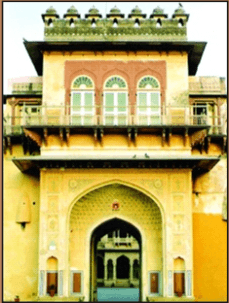
The evaluation of the Built Heritage of Jaipur leads to outlining major issues and concerns linked to heritage conservation works that can formulate guidelines for heritage policies and actions. The laws, legislation and policies for protection and conservation of heritage structures in the city of Jaipur.
Currently, the Rajasthan Conservation and Heritage Byelaws, 1961 guides the conservation of the cultural properties. Besides this, there are building byelaws that restrict or control building activities in walled city and heritage buildings. The byelaws include:
- No permission for erection, re-erection, addition or alternations of any building without sanction from the competent Authority;
- Prohibit construction of buildings in open spaces or over tanks;
- Regulate building line, corners buildings, drainage, plinth, chimneys, services, minimum areas for rooms, height of rooms and the building, etc.
Heritage cell created by Government which is in the process of revising and strengthening these byelaws for the listed heritage zone, precincts and structures.
The protected monuments in Jaipur area fall under the jurisdiction of ASI or State Department of Archaeology and hence are protected as per The Ancient Monuments and Archaeological Sites and Remains Act, 1958 or Rajasthan Monuments, Sites and. Antiquities Act 1961 respectively.
The Tourism Policy of the Government of Rajasthan highlights the conservation of heritage buildings. The policy points linked to heritage conservation include:
- Proposes consolidation of facilities to make fairs and festivals more attractive;
- State Archaeology Department, Devasthan Department, Waqf Board etc. to support efforts at revival of traditional building arts, to offer to private individual or firms or voluntary organizations interested in preservation of individual monuments on settled terms and conditions, and
- To carry out studies to assess the carrying capacity of popular tourist destinations with a view to regulate tourist traffic in them.
- The natural heritage of Jaipur is protected under the central Acts enforced by the Ministry of Environment and Forest such as the EPAAct (1986).
1.8 Social Infrastructure
In the U1 area about 5.5% of land use is dedicated to public and semi public facilities other than this residential use zone further have provision for public and semi public facilities. Social infrastructure at various levels viz; neighbourhood level, sector level, Zonal level etc., shall be provided as per standards. Zonal Development plan will further describe the public facilities and other social infrastructure in detail.
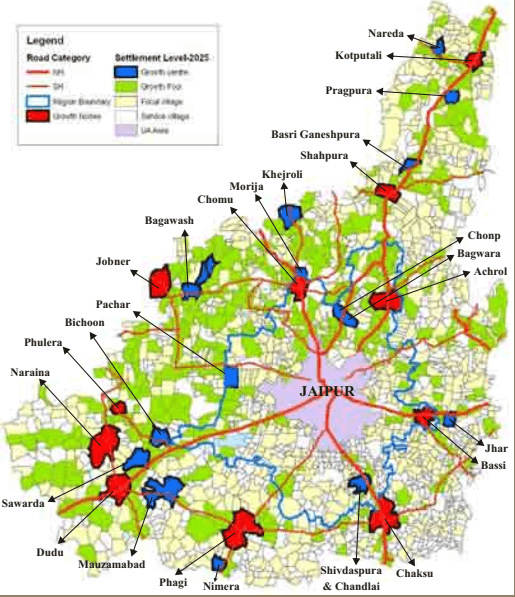
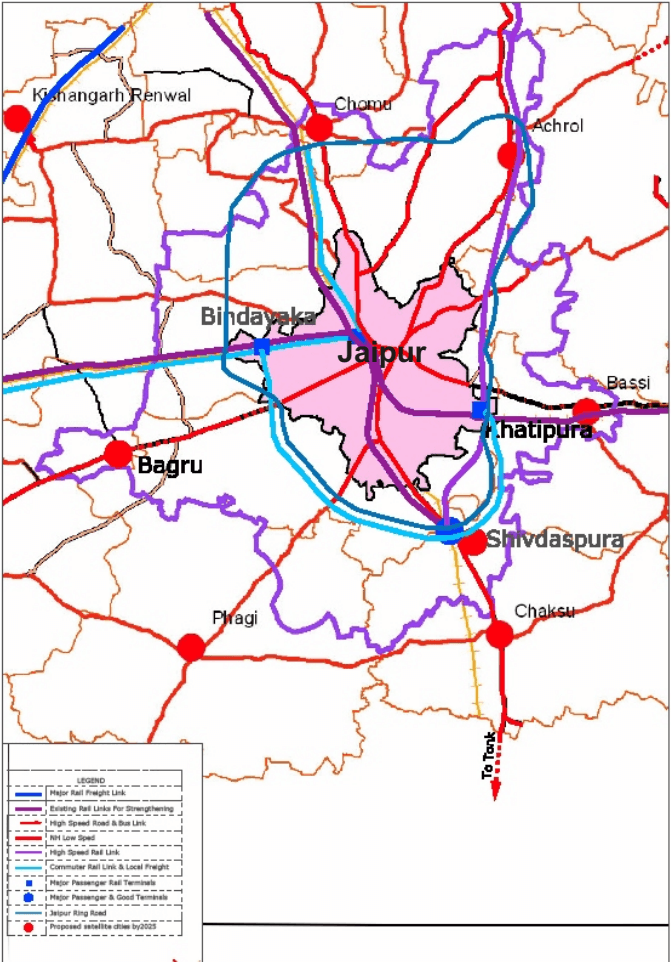
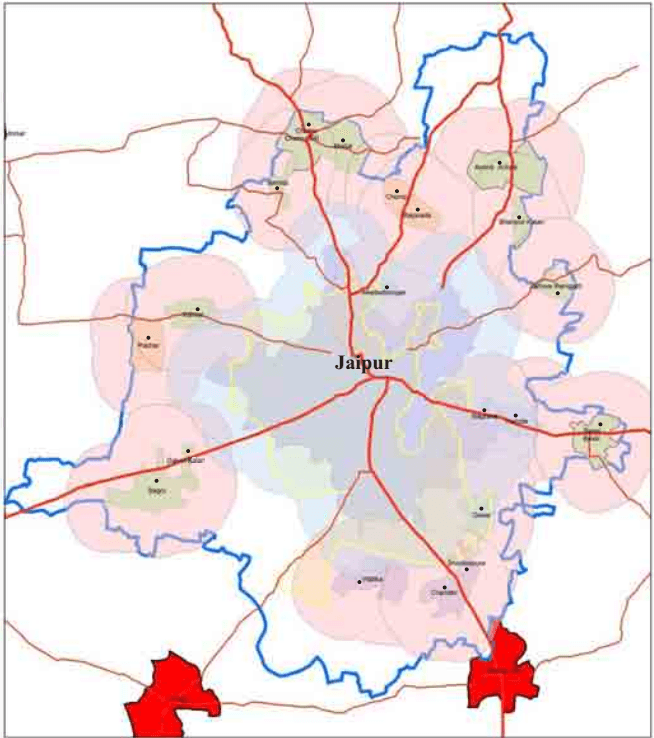
Satellite towns also have provision for adequate public & semi public facilities. MDP 2025 have provision for required social infrastructure viz' health, education, banking, post & telegraph and recreation etc., for satellite towns as well as villages falling in Jaipur region.
In the Chonp town app. 75% of land use is dedicated to public/semi public purposes, the town is dominated by Institutional use. The institutional use is attempted to make the growth center as institutional destined settlement. The North-East area of Chonp settlement is reserved for Knowledge city.
On the same line Achrol also acts as an institutional destination, A major portion of the land use falls under JDA's science tech city which boasts of becoming premier educational Hub on Delhi road. All the public semi public use in the town in interwined with provision of large recreational areas and suitable connectivity.