Land, finance and manpower are the three main resources for planning and development of urban and regional centres. As a basic principle, allocation of these resources among various competing land uses must be such that it helps in achieving an optimal level of economic efficiency with inclusion and equity 1 .
In case of spatial development and various development programmes, the government has been normally considered as the sole source for finance and ownership. However, in the recent years the role of private sector in the development process has been duly recognized. As a general policy on resource mobilization, it would be desirable to have a proper mix of public and private sectors participation, both playing a symbiotic role in such a way that the public infrastructure programmes are implemented with the strength of public authority and efficiency of the private entrepreneur. This should be the framework for PPP. The role of people is also being recognized, leading to development of the PPPP model.
This chapter focuses on the fiscal resource mobilization, land resource mobilization, good governance and manpower resources mobilization strategies for development. The local authorities, chief town planners, city commissioners could select the most appropriate model and combination depending upon the contextual possibilities.
3.2Land
3.2.1 Land as a Resource
Land is the medium on which the entire superstructure of human settlement is created and under which a lot of infrastructure find their place. Planning for the use of land leads to socio-economic and physical development of urban and rural areas. However, it is a scarce commodity as its supply is limited and it cannot be mass created. The (Draft) National Land Utilization Policy, 2013 states that land is required for development of essential infrastructure and for urbanization, while at the same time there is also a need to protect land under environmentally sensitive zones and land which provides ecosystem services. Farmers' livelihood options and food security issues make it imperative to protect land for agriculture. Further, the need to preserve natural, cultural and historical areas requires land protection. It is, therefore, most essential to ensure
1 Technology and capacity to handle the various resources can also be defined as a resource.
that utilization of the available land is judicious and in the best interest of the community through the instrument of development plans.
3.2.2Land Economics
Land value depends on demand and supply of land. The value increases as the demand exceeds the supply, which is the general case, owing to limited supply of land against it growing demand in the wake of urban growth and development. The Right to Fair Compensation and Transparency in Land Acquisition, Rehabilitation and Resettlement Act, 2013(RFCTLARR Act, 2013), defines “land” so as to include the benefits that arise out of land, and things attached to the earth or permanently fastened to anything attached to the earth 2 . The Act also requires that the market value of land be calculated as the minimum land value specified under the Indian Stamp Act, 1899 for the registration of sale deeds in the area, where the land is located, or the average of the sale price for similar type of land located in the immediate areas adjoining the land being acquired. It is to be ascertained from fifty per cent of the sale deeds registered during the preceding three years, where higher price has been paid. This approach is suggested for determining the market value of land for acquisition.
The Land Acquisition Act of 1894 was made mainly to facilitate the government to procure privately held land for the purpose of developing public infrastructure and also for companies. After 120 years, this Act was replaced by the RFCTLARR Act, 2013. The Act has provided for fair compensation to those whose land is acquired permanently or temporarily, while bringing in enhanced transparency to the process of acquisition of land.
3.2.3Land Assembly
Land assembly and development mechanism are undertaken for achieving optimum social use of urban land and to ensure adequate availability of land to public authority and individuals. Public private participation is achieved in land development through various techniques. Mainly, land assembly techniques prevent concentration of land in few hands and promote its efficient social and economic allocation. Some of the land assembly techniques also promote flexibility in land utilization in response to changes resulting from growing city. The various mechanisms to assemble and/or develop land are enlisted below:
■ Land Acquisition: bulk land acquisition by State and by private initiatives.
- Land Pooling: land pooling approach and redistribution scheme, popularly known as Town Planning schemes.
- Land Reservations: the concept of Accommodation Reservation which allows the land owner to develop the sites reserved for an amenity.
2 Appendix B of Volume II B provides definition for land and associated terms.
■ Transferable Development Rights: a technique of land development which separates the development potential of a land parcel for use elsewhere.
Guided Land Development: this model uses the provision of infrastructure as an instrument to guide urban development in partnership with landowners without pooling any land.
3.2.3.1 Land acquisition
“Land Acquisition” popularly means the acquisition of land for defined public purpose by a government agency from individual landowners, as authorized by the law, after paying a government-fixed compensation to cover losses incurred by landowners from surrendering their land. The land acquisition process can be undertaken by the State or through private initiatives. As of now, most of the land acquisition is to be processed as per the RFCTLARR, 2013. Some models of land acquisition are as follows:
Bulk land acquisition method as a State Initiative:
In this method, Master Plan is prepared for the entire area encompassing different land uses and involving various activities. Land is developed in accordance to the planning norms for various uses/activities. Bulk land is acquired from farmers by the development agency and compensation is paid to farmers/owners based on the provision of prevailing act.
Bulk land acquisition method with Private Initiative:
To defray the cost of land acquisition some state governments and ULBs have developed models in which private sector acquire land by directly paying compensation to the affected families. A variety of models are in existence per which land is acquired for planned development with private partnership.
Haryana Guided Land Development Model: In this model, the private developer can acquire land directly from farmers at market price and at the same time, it permits a land owner to assume the role of a colonizer. This model provides fixed time period of 5 years to utilize that land acquired (initially 2 years, then extension of 3 years, if required) and the developer is expected to complete the projects within this period. Major highlights of this model are that the difficulties and delays inland acquisition are avoided and pressure on government to pay compensation is reduced, overall enhancing investments.
Ghaziabad Joint Venture Model: As per approach followed by Ghaziabad Development Authority (GDA), a joint venture (JV) is formed between the GDA and the builders/developers/co-operative societies through open bid (based on technical and financial capabilities). Twenty per cent of the plots developed are to be reserved for EWS/LIG and the costing and allotting of social facility by developer has to be done as per the government regulations. The balance of the land is to be sold by the developer at profit. For the entire process, the
development authority acts only as a facilitator. Project duration is specified in the JV agreement and penalty is imposed if developer requires time extension, thus making sure that land is utilized within the stipulated time period.
Hyderabad Differential Compensation Models: In Hyderabad, the land acquisition technique has been modified into two different models, in which while acquiring land for public and private projects, different level of compensations are arrived at, these are-
Model I: When land is acquired for projects mainly for public purpose such as roads, power generation and distribution, irrigation, schools, welfare housing, environmental projects etc., appropriate compensation is paid to landowners by consulting them.
Model II: When land is acquired for projects such as SEZ, Industrial Estates, Satellite townships and others where value addition enhances the land prices substantially, mainly for third party use, compensation is normally worked out on profit sharing basis, which is in two parts, namely-
• Basic Value (Government Rate) of Land
- % Equity Sharing in SPV / % of Net Developed Area / Built Space
CIDCO Model of Land Development in Navi Mumbai follows the technique of land banking for land assembly. The compensation to land owners is done by the way of monetary and land compensation. But in Vasai Virar sub-region, CIDCO undertook the land assembly by obtaining power of attorney from landowners or outright purchase of freehold lands located close to each other by private developers or builder. The promoter is solely responsible for providing and maintaining infrastructure for consolidated land parcel.
3.2.3.2 Land pooling
In Town Planning or Plot Reconstitution Scheme, the land is pooled and its development is financed with the involvement of landowners without compulsorily acquiring land. This land assembly technique helps to provide plots for basic services in a planned layout from the original haphazard arrangement. Costs incurred by the developmental authority for development and for infrastructure are recovered from the sale of few of the final land plots reserved by the authority and betterment charges levied on land owners. The reconstituted plots are allotted to the landowners in proportion to their original land holdings.
The scheme was first introduced in the Maharashtra Regional and Town Planning Act, 1966 and later in Gujarat Town Planning & Urban Development Act, 1976 and is now widely appreciated model of land assembly. Another deviation of the land pooling mechanism has been recently introduced by the Delhi Development Authority (DDA), wherein DDA facilitated developers and landowners to pool land for development.
The town planning scheme is referred as ‘land acquisition without tears’ and has the following key advantages:
■ Infrastructure is provided in coordinated way.
■ Partial cost is recovered through betterment charges.
- Land for public and community purposes including green & open spaces is acquired without direct expanses.
■ Community benefits through unified planning.
■ Landowner shares the project cost and benefits by increased property prices.
However, the Land Pooling Scheme suffers from certain difficulties, such as:
- Delay in process of preparation, approval, arbitration and implementation, mainly due to litigations.
There are issues related to cost recovery.
There is also inadequate public participation in such schemes. To overcome the drawbacks of TP scheme, some suggestions are enlisted below:
■ Division of scheme into planning and financial part, which has been done in the Gujarat model.
- Appointment of an arbitrator and a project planner by local authority to modify the plan after initial preparation, who would undertake active consultation with original stakeholders pre and post plan preparation.
The contribution, which is based upon the estimated value of land assuming full development as per the scheme, should be replaced by estimated cost of the scheme.
■ Provision of Transferable Development Rights in lieu of compensation to original plot holders can be considered.
- Land pooling schemes to be prepared only for the areas included in current development plan.
Land development for Schedule-6 areas: Some North-east states have areas covered under the Schedule 6 of the Constitution. In such areas, land development and planning are not directly under the control of the State government but vests with the Autonomous District Councils and mainly under community ownership. Therefore, communities can be involved in development process of the settlements as it may be viable and easier approach.
3.2.3.3 Land reservations
The concept of Accommodation Reservation allows the land owners to develop the sites reserved for an amenity in the development plan using full permissible Floor Space Index (FSI)/ Floor Area Ration (FAR) on the plot, subject to agreeing to entrust and hand over the built-up area of such amenity to the local authority free of all encumbrances and accept full FAR/FSI as compensation in lieu thereof. The area utilized for the amenity would not form part of FAR/FSI calculation.
Reservations such as retail markets, dispensaries, etc. can be implemented in this way wherein local authority is not required to acquire the land by incurring expenditure on payment of compensation. In case of reservations like shopping centres etc., the owner can be allowed to develop these on agreeing to give at least upto 25% of the shops to the local authority for the purpose of rehabilitation of the displaced persons on payment of cost of construction.
In case of road widening/ new construction, the local authority can grant additional FSI on 100% of the area required for the purpose, provided the owner surrenders the land for widening or construction of new roads to the local authority free of all encumbrances and accept the additional FAR/FSI as the compensation in lieu thereof. This mechanism has considerably relieved local authorities from incurring huge expenses for the purpose of acquisition of such lands. The model can be explored for other non-economic activities such as open spaces, public utilities among others.
The concept of accommodation reservation has been incorporated in the Development Control Rules of the Mumbai Municipal Corporation.
3.2.3.4 Transferable Development Rights (TDR)
TDR is a technique of land development, which separates the development potential of a particular parcel of land from it and allows its use elsewhere within the defined zones of the city. It allows the owner to sell the development rights of a particular parcel of land to another. This entitlement is over and above the usual FSI available for receiving plot in accordance with the prevailing laws and regulations, which entitles a landowner to construct additional built-up area on his existing building or vacant land.
TDR is taken away from the zone and it is tradable which makes it different from Accommodation reservation. This is also generally used for redevelopment of inner city zones and for reconstruction/ re-development and has been tried out in numerous cities/ States including Bengaluru, Chennai, Mumbai and Rajasthan. However it has its prospects and consequences as experienced from the implementation in various cities. For instance, unbridled pooling of TDRs could damage the urban form! Hence it should be used carefully. States like Karnataka and Rajasthan have made provisions to mitigate such effects.
3.2.3.5 Guided Land Development
Guided land development model uses the provision of infrastructure as instrument to guide urban development. This is done in partnership with landowners who pay for the cost of providing services to their land and in return donate land for public infrastructure and a payment as betterment levy. This model, also proposed by the United Nations Economic & Social Commission for
Asia & Pacific (UNESCAP), has been for guiding the conversion of privately owned land in the urban periphery. It uses a combination of traditional government role of providing infrastructure and the enforcement of land subdivision regulations. The key advantage of the approach is that it is less costly than outright land acquisition and more equitable than land banking.
The principle behind guided land subdivision is that the government agency proactively selects the direction where it feels urban development should take place and provides infrastructure in those areas. This acts as an incentive to encourage developer to invest in the planned area selected by the government agency. The cost effectiveness of guided land development approach results from the fact that land development is planned, designed and implemented with the landowners of the designated area, who donate land for roads and right of way for infrastructure and public spaces, as well as pay a betterment levy to meet the costs of the project. To finance the scheme, a loan is initially taken to build the infrastructure, which is paid from betterment levies provided by landowners either on annual installments or in lump sum upon sale of land. The infrastructure is provided by the government agency upto the site. Individual landowners are supposed to subdivide their land for various developments and lay the on-site services.
But Guided land is often fraught with difficulties on the ground. First, as the model depends on the consent of the landowners it cannot be applied in areas with fragmented landownership, lack of owners' will and consensus. Second, collection of betterment levies may not be feasible by small landholders and lead to default of payment.
3.2.4Inclusive Land Development
Most cities in developing countries suffer from land market distortions caused by poor land development and management policies including poor planning, slow provision of infrastructure and services, poor land information systems, cumbersome and slow land transaction procedures, as well as under regulation of private land development, leading to unplanned or ribbon/corridor development of land in the urban periphery. The urban poor suffer most from a dysfunctional city. Distortions in the land markets allow land speculation, which often prices the poor out of the formal land markets and into the informal land markets, which are exemplified by slums, squatter settlements and illegal subdivisions, mainly in the periphery of cities. This leads to longer commuting time and costs, poor living conditions, in adequate infrastructure and services, adversely affecting the health and financial condition especially of the poor, thereby entrenching the cycle of poverty.
Land and housing have special significance for the poor. Often for poor, a house is not just a shelter, but is also a place for income generation. Urban settlements
of the poor in the region are characterized by home based workshops from which the poor earn their incomes. Though slum, squatter and illegal settlements are often used interchangeably but they are different from each other and denote different characteristics of the settlement.
- Slums are legal but substandard settlements, with a lack of adequate services and overcrowding.
- Squatter are settlements where land has been occupied illegally. They are often found on marginal or environmentally hazardous lands, such as close to railway tracks, along rivers and canals etc. They are also found on government land or land whose ownership is unclear.
While squatter settlements are spontaneous and unorganized, illegal settlements are planned and organized. These usually occur in cities where the government owns large tracts of vacant land, with low opportunity cost.
3.2.4.1 Inclusion of Poorer Section into the Formal Land / Housing Market
Experience has shown that bringing the poor into the formal land and housing markets needs a two pronged strategy: increasing the choices available on the supply side and increasing affordability on the demand side.
Increasing supply of land for the poor includes following:
- Sites and services: It provides the target group with a plot and basic infrastructure, such as water, roads and sanitation facilities.
- Illegal settlements regularization/upgrading: Settlement upgrading provides existing settlement dwellers land tenure, as well as, basic infrastructure.
- Landsharing: Landowner and the land occupants reach an agreement whereby the landowner develops the economically most attractive part of the plot and the dwellers build houses on the other part with full or limited land ownership.
- Sites without services- incremental development: The approach includes mechanisms whereby groups of households are encouraged to organize themselves, accumulate funds and provide infrastructure gradually.
- Private developers to provide a percentage of FAR (DDA norms provides 15%) for EWS housing to be handed over to LB/ Authority at predetermined price.
- Reservation for servicepopulation including domestic help, cleaners, drivers, other small scale and informal services should be made (DDA norm in 50%).
The strategy of increasing effective demand for land for the poor has following schemes which can be used to provide better shelter to the urban poor:
- Community organization: Organized communities of the poor can afford housing and they also negotiate with governments and other stakeholders more effectively.
- Increasing savings and providing access to finance: Community-based savings-and-credit schemes preserve organized communities and increase access to finance.
- Improving income opportunities by providing access to the Central and State level schemes for employment (like Swarna Jayanti Shahari Rozgar Yojana, Urban Wage /Self-Employment Programme, Women Self-help Programme) and vocational trainings (like Skill Training for Employment Promotion).
(Source: UNESCAP- Urban Land Policy for the Uninitiated, DDA Norms and other sources.)
3.3Fiscal Resource Mobilisation
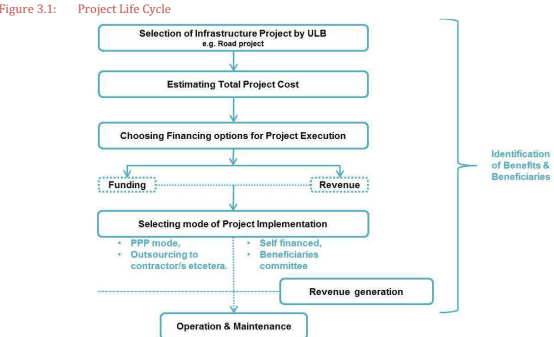
Local bodies play an important role in providing social, civic, physical and economic infrastructure services to the public. Municipal finances are critical in initiating many urban and local governance projects, as financial resources' strategic management plays a vital role in ensuring long-term sustainability of local services and infrastructure. With the introduction of 73rd&74thCAA, local government's role and responsibilities have been increasing continuously. To realize these responsibilities local governments require steady flow and efficient management of financial resources. However, as the traditional system of funding on basis of plan and budgetary allocations will be reduced, the local authorities will have to devise innovative methods of resource mobilization through fiscal instruments and accessing the market. The subsidies will need to be rationalized and urban development plans and projects need to be designed as commercially viable. A general lifecycle of a project is depicted in Figure 3.1.
Also the estimation of project cost is to be accurately calculated including contingencies. The important head for project cost calculation are:
Capital Investment (Capex), including-
- Land cost
– Common infrastructure cost, like roads, water supply etc.
– Project specific infrastructure cost like toll plaza, bridge- s
– Building and civil cost
– Interest during construction
Working capital margin (also incidental expenses)
Operations and Maintenance cost (s) (O&M), including-
- Salary & Wages
– Recurring raw material cost
– Repair & Maintenance
– Administration & overheads
– Marketing expenses
– Project specific operating expenses
Requirement of finance in the project life cycle is for implementation and then later for operation and management. The first activity is raising funds in bulk to initiate a project. Once construction is over, the later stage of operation and maintenance requires steady flow from revenue sources. However, only well planned and implemented infrastructure projects generate revenue income for local authorities in form of fees and charges. Figure 3.1 depicts general life cycle of a project. Various innovative and traditional approaches for financing developmental activities are available these days and an attempt to prepare a comprehensive list has been made, as presented in Figures 3.2 &3.3 below.
3.3.1Traditional and Innovative approaches for Fiscal Resource Mobilisation
Diverse options of the source finance are available for developmental projects. These traditional and innovative sources of financing projects at State and ULB level through funding and revenue sources are detailed below:
a. Taxes: State government authorises local governments by law, to collect taxes. Taxes are major source of revenue of Urban Local Bodies. Property tax, profession tax and advertisement tax are major sources of revenue in local governments.
b. Charges and fees: Local bodies levy charges and fees for the services provided to citizens. These charges, for water supply, solid waste management, parking and other such services to cover the cost of undertaking the provision of services.
c. Grants and Subsidies: Grants and subsidies are generally given by central government to state/ local government or State to local government for development and provision of services to citizens.
d. Public Private Partnership: PPP is an agreement between public and private entity for providing services or infrastructure to citizens. It helps municipal authorities to shed some of its functions and evolve alternative institutional arrangement for the performance of such functions.
e. Loans from financial institutions: Public and private organisations come together to pool funds from public and investing it in financial assets. Such loans are for long term.
f. Funding by Bilateral and Multilateral Agencies: These are developmental agencies which provide soft loans for infrastructural projects. Almost all such loans are backed by sovereign guarantee and take long process to access.
g. Foreign Direct Investment: FDI is direct investment from company or entity into a foreign country.
h. Pooled Finance Development Fund (PFDF) Scheme of Government of India: PFDF is meant to provide credit enhancement grants to enable ULBs to access market borrowings to facilitate development of municipal infrastructure.
i. Municipal Bonds and Debentures: Municipal bonds and debentures are issued by ULBs and Infrastructure Funds, to general public or specific institutional investors to raise finance for developing physical infrastructure.
3.3.1.1Taxes (Property taxes, Vacant developed land tax)
The municipal entities derive their tax powers from the laws enacted by the State legislatures. The sources of revenue – both tax and non-tax are delegated to them under these laws as obligatory and discretionary taxes. However, the municipal bodies are at the liberty to levy a tax and may or may not levy all the entitled taxes.
In order to match the functional domain of municipal bodies with tax power, it is imperative to devolve additional tax powers to municipalities and to provide for transfer of new functions to them as proposed in 73 rd & 74 th CAA, along with the requisite funds which currently are under the purview of State Government Departments.
In addition to taxes, state governments also provide authority to local bodies to levy ‘surcharge’ on some taxes to generate additional fund to meet its requirements. Following is the list of taxes and surcharges that local bodies can levy to generate revenue.
Taxes:
Property tax on lands and buildings: reforming the property tax entails bringing in amendment of inherent Rent Control Laws either for delinking its present depressing effect on rental value or for permitting legally the periodical revision of standard rent. The Model Rent Control Act of MoUD provides for refurbishing of standard rent and its periodical revision. This, if adopted by all the states, will go a long way in restoring the base of this tax with some relationship with the market value.
- Stamp Duty: This tax is levied on those instruments or documents of transactions when selling and buying property. The proceeds in regard with this duty go directly to State in which the individuals are levied. It can also be shared with Local Bodies.
Tax on land/property values increment: It is common phenomenon that land values keep on increasing over the years not because of any individual effort but due to implementation of development schemes. Land values increment may also be due to economic phenomenon of rise in general prices. The basic objective of land value increment taxes is to capture some of this increase for the benefit of the community.
Water tax: The Municipality can levy a water tax on any land or residential building or non-residential building as a percentage of property tax as specified by regulations.
■ Fire tax: The Municipality can levy a fire tax on any building as a percentage of property tax as may be specified by regulations.
Tax on congregations: It is a tax levied per head or per vehicle for providing municipal services to persons or vehicles visiting the municipal area for the purpose of tourism or in connection with any congregation of whatever nature, including pilgrimage, fair, festival, circus or yatra, within a municipal area for persons or vehicles assembling within the municipal area for the purpose.
Tax on pilgrims and tourists.
Tax on deficit in parking spaces in any non-residential building: This tax is on the deficits in the provision for parking spaces required for different types of vehicles in any non-residential building.
- Advertisement Tax: Such tax can be levied for the exhibition or display of any advertisement (other than in newspaper) to public view in any manner.
■ Vehicle tax: It is a tax on purchasing vehicles and using roads.
■ Profession Tax: Profession tax is levied by municipal authority on individual, company, business owners or merchants' It is levied on the income earned by way of trade, profession, employment or business.
Domestic Servants Tax: This tax is payable by employer on domestic servants.
Vacant land tax: In some urban places, the land is kept vacant without any use by the owner for a period of time. A tax is payable on vacant land to incentivize its development or sale to those who have the interest and access to resources to develop it. It is recommended to levy this tax as per applicable FAR rather than availed FAR.
- Octroi: This tax is levied on the entry of goods into a local area for consumption, use, or sale. Many States have replaced octroi by entry tax levied and collected by the State Government, but shared with the Local Bodies.
- Other taxes: The municipalities can also levy any other tax, which the state legislature has the power to levy, subject to the prior approval of the state government.
Surcharges:
Some States provide for levy of surcharge on State taxes, to be passed on to the local bodies, though some economists find such surcharges to be distortionary. Examples are-
- Surcharge on stamp duty: The Municipality can levy a surcharge on the transfer of lands and buildings situated within the municipal area as a percentage of stamp duty levied on such transfer.
- Surcharge on entertainment tax: It is a surcharge on any tax levied by the state government on any entertainment or amusement within the municipal area.
- Surcharge on electricity consumption: It is a surcharge on consumption of electricity within the municipal area.
- Surcharge on petroleum products: State governments levy sales tax on petroleum products and additional surcharge to cover the financial demands of local bodies.
Tolls:
Toll is a form of tax, typically implemented to help recover the cost of road construction and maintenance.
Roads& Bridges: A Municipal authority can establish a toll-bar on any public street or bridge in the municipal area and levy a toll at such toll-bar on vehicles, over and above the vehicle tax, for specified reason.
- Ferries: Where a ferry plies between two points on a water-course and either one or both the points are situated within a municipal area, State Government can declare such ferry to be a municipal ferry and levy toll or tax.
■ Heavy trucks: It is a toll on heavy goods or passenger motor vehicles, plying on a public street. This is to control heavy passenger motor vehicles movement in the restricted hours of the day and in the restricted areas.
- Toll collection on navigation channels: The State Government can levy tolls for use of any navigable channel, which passes through the limits of a municipal area in lieu of the maintenance of navigation channel.
Table-3.1: List of various Taxes, Surcharges, Charges, Fees and Tolls as may be levied for Urban & Infrastructure Development
Heads
Sources of Revenue
Taxes
Property tax on lands and buildings
Water
Vehicles and other conveyance
Electricity Cess
Conservancy
Property: (Lighting, water, drainage, general purpose, sanitary)
Drainage
Motor vehicles
Education cess
Congregation
Profession
Sanitary
Non-Motorized vehicles
Special education tax
Sale of cattle in the market
Stamp duty on transfer of properties
Fire
Terminal
Pilgrims and Tourist
Carriage and animal
Stamp duty on transfer of immovable properties
Electricity
Local body tax on entry of goods
Artisans
Scavenging
Deficit parking space in any non-residential building
Special water tax
Trade
Timber
Animals
Land according to circumstances & property
Latrine
Markets
Boats
Dogs
Building application
Garbage Treatment
Advertisement
Menial domestic servants
Dogs Latrine
Vacant land development tax
Special and general sanitation
Theatre
Octroi*
Surcharges
Transfer of lands and buildings
Tax/charge/ fee on Buildings
Electricity consumption
Entertainment
Petroleum products*
Charges
Development charges
Water-supply
Drainage
Solid Waste Management
Sewerage
Betterment Levy
Other specific Services rendered
Stacking of material or rubbish
Fees
Sanction of building plans
Building betterment
Compounding
Hotel / Restaurant
Carts
Issue of completion certificates
Betterment /Development Fee
Warrant fee
Swimming pool
Carriages
Licensing: Professionals, activities
Building construction
Nature and cost of Internet services
Food adulteration
Registration of Dogs and Cattles
Issue of Birth and Death certificates
Advertisement Fee
Street
Compounding
Cattle pounds
Birth and Death registration
Boats (rental)
Pilgrim
Dangerous and Offensive trade license
Animals
Mutation
Fire Brigade
Drainage
Market
Slaughter house
Registration
Public Health
Lighting
Composting
Scavenging
Trade License
Water Connection
Fee for sale of Goods
Stock Registration
Tolls
Roads
Bridges
Ferries
Heavy trucks
Navigable channel
Source: Compilation of State wise applicable taxes and fees as in 2004. * Taxes and surcharges which may be abolished.
3.3.1.2. Charges and Fees (Development Charges, Levies, Impact Fees, non-tax sources, valorisation charges, service charges)
Charges are a fee charged by a consumer's local body to recover the costs of specific community/physical services. For example, municipal charges of water supply may go to cover costs of laying water supply infrastructure and water treatment plant in a city. Betterment charges are usually imposed on the beneficiaries of the improvement projects to recover the project cost. Development charge is used for recovering the cost of providing new services and infrastructure in an area.
The Municipality can levy user charges for following services provided in the urban areas:
■ Provision of water-supply, drainage and sewerage
Solid Waste Management
- Parking of different types of vehicles in different areas and for different periods
- Stacking of materials or rubbish on public streets for construction, alteration, repair or demolition work of any type
■ Other specific services rendered
Transit Corridors attracts economic activities and concerted development where provision of additional infrastructure or its augmentation requires additional financial support. Therefore, such areas call for self-financed urban infrastructure projects. Alternative possibilities to raise revenues in these areas can be by tapping land-based financing sources along dense transport corridors, these options can be:
- Higher Conversion charges especially for commercial and economically lucrative activities.
- Higher Development charges or Betterment levy on land uses which put more pressure on infrastructure Impact fees or higher charges on the purchase of extra FSI/FAR along the corridor upto a maximum prescribed by the authority.
Overall additional changes and fees such as higher property tax, special water tax (mentioned in the Table 3.1).
Non tax source for the use of particular services, such as Service charges for parking in the TOD influence zone, fire safety facilities in the zone among others.
Apart from the TOD focused charges, the Municipality can levy fees and fines for the following services and activities to generate revenue:
■ Sanction of building plans and issue of completion certificates,
■ Issue of municipal licenses for various non-residential use of lands and buildings,
- Licensing of various categories of professionals, activities such as sinking of tube-wells, sale of meat, fish or poultry or premises used for private markets, slaughterhouses, hospitals, animals, carts or carriages and other activities.
- Sites used for advertisements in roads, parking lots, commercial locations and public building,
■ Issue of birth and death certificates.
- Impact Fees: It is a fee imposed on builder, developer on industrialist to compensate the impact and burden new project is going to have on social and physical infrastructure (existing and need for new) and environment.
3.3.1.3Grant-in-aid and Subsidies
Central Finance Commission (CFC) evolves a comprehensive framework for the distribution of the grants-in-aid between states, including those for the local bodies. Further, the 13 th Finance Commission has introduced other grants namely, general basic grant, general performance grant and special area basic grant. Similar provisions are made by the State Finance Commissions. In addition, Planning Commission recommends Development (or Plan) Grants to States, including for the local bodies.
A capital grant is usually utilized for capital expenditure like purchase of land, building, equipment, facilities, etc. The benefits of such expenditure are of an enduring nature and spread over an extended period of time, such as road development grant.
The revenue grant is generally utilized for meeting recurring expenditure, the benefits of which usually expire within the accounting year in which it is incurred. Revenue Grants are usually in the nature of a subsidy. Subsidies are provided, directly or indirectly, for the provision of services such as water
supply, disposal of sewage, transporting and disposal of wastes; municipal transport, street lighting, hospitals and schools.
3.3.1.4Public Private Partnership (PPP)
One of the ways to enhance fiscal capabilities of the municipal authorities is to shed some of their functions and evolve alternative institutional arrangement for the performance of such functions. Public Private Partnership is such arrangement between a government / statutory entity / government owned entity on one side and a private sector entity on the other. This partnership is for the provision of public assets or public services, through investments being made and management being undertaken by the private sector entity, for a specified period of time. There is well defined allocation of risk between the private sector and the public entity. The PPP arrangement ensures that private entity receives performance linked payments that conform to specified and predetermined performance standards, measurable by the public entity or its representative.
PPP models are generally classified in the categories enlisted below and detailed in section 3.3.3:
■ Management Contracts
Turnkey Projects
Lease
Concession
Private Ownership
3.3.1.5Loans from Financial Institution(s)
A financial institution is either in public and private sector which brings funds from the public and puts them in financial assets rather than physical property. Such institutions are made up of different organizations such as banks, trust companies, insurance companies and investment dealers. Specialized financial institutions e.g. IDFC, NHB, HUDCO and IL&FS are some agencies which provide loans and a variety of instruments for infrastructure financing. Other financial institutions e.g. ICICI, LIC of India, etc. also provide funds for infrastructure projects. These institutions have access to funds which are for longer duration e.g. loans from development agencies, bonds from open market, foreign institutional investors, etc. and are thus able to lend for relatively longer durations than banks.
Credit rating of the ULB plays an important role here. The better the credit rating for repayment of principal and interest, lower is the rate of interest. Certain financial institutions provide credit enhancement mechanisms to enhance the inherent credit quality to obtain a better credit rating resulting in lower interest rates. This facility is now also being extended by MoUD through its Pooled Finance Development Fund (PFDF) scheme. Institutions may also provide guarantees for funds accessed from other sources. (Source: Municipal Finance Improvement Programme-JnNURM)
Banking institutions also provide finance to local authorities. Bank loan is a relatively new avenue and an easier option for finance for Local Bodies, as the banks have prescribed norms and well laid down procedures. The time period of these loans are short to medium term and generally do not cater to the long tenure needs of infrastructure projects. Bank loans are available to finance the short term needs of institutions e.g. working capital loan, bridge loans, loans against property etc.
3.3.1.6Funding by Bi-lateral & Multi-lateral agencies
Bilateral organizations are government agencies or non-profit organizations of a country that provide aid to other countries. Bilateral organizations receive funding from their national governments, and use the funding to aid developing countries. Few bilateral agencies are as follows:
■ US Agency for International Development (USAID)
■ Department for International Development (DFID; UK)
■ Japan Bank for International Cooperation (JBIC)
Japan International Cooperation Agency (JICA)
Australian Aid Agency (Aus Aid)
Multilateral organizations are international organizations whose membership comprises member governments, who collectively govern the organization and are the primary source of funds, while the loans/grants-in-aid are provided for projects in various countries. Some examples of multilateral funding agencies are:
■ Various United Nation (UN) bodies
■ World Bank
■ Organisation for Economic Cooperation and Development (OECD)
Asian Development Bank (ADB)
Bi-lateral and Multi-lateral bodies are also known as Development Agencies. These provide soft loans and grants for infrastructure projects. Accessing funds from these agencies is relatively a long process and it requires preparation of various project documents - in-depth planning, and studies to assess compliance of the project with respect to environment, rehabilitation / resettlement and social safeguard policies, and pilot testing of new initiatives. As almost all loan projects of bi-lateral and multi-lateral agencies are backed by a sovereign guarantee, the Department of Economic Affairs, Ministry of Finance, Government of India plays an important role during the entire process. In line with the development financing objectives of these institutions, projects funded by these institutions are typically in sectors that are not commercially attractive. Local bodies can receive external development assistance from bilateral and multilateral sources on behalf of the State Governments for State sector projects/programmes. (Source: Municipal Finance Improvement Programme-JnNURM)
3.3.1.7Foreign Direct Investment
Funds from Foreign Direct Investment (FDI) have emerged as a major source of funds in infrastructural projects in India – for instance Japan's (Japan Bank of International Cooperation) FDI support in developing the Delhi Mumbai Industrial Corridor (DMIC).
Under FDI Policy 2013, almost all the sectors have been opened for 100 per cent FDI except agriculture, mining and petroleum and natural gas, manufacturing, service sector and financial services. The sectors in which hundred per cent FDI is permissible are construction (townships, housing and built up infrastructure), Industrial Parks and Airports with few conditions. Hence FDI support for financial resource mobilization is easily available, which could be permitted through financial collaborations, joint ventures/technical collaborations, capital market, preferential allotments etc.
3.3.1.8Pooled Finance Development Fund scheme by GoI
Small and medium sized cities find it difficult to raise resources from the market for infrastructure projects due to lack of project structuring capabilities and creditworthiness. The Government of India has launched the Pooled Finance Development Scheme (PFDS) to enable these local bodies to bridge this gap through accessing market funds for their infrastructure projects. The scheme is meant to provide credit enhancement grants to enable local authorities to access market borrowings through Pooled Finance Municipal Bonds (PFMB) for investment in urban infrastructure projects.
PFDS facilitates ULBs in municipal infrastructure by helping them access capital and financial market for investment in essential projects. It facilitates local bodies in developing bankable urban infrastructure projects. With appropriate credit enhancement measures it helps ULBs in reducing the cost of borrowing from market, on the other hand strengthening the municipal bond market.
The PFDS creates an incentive structure to support urban reforms, which would also be driven by covenants of financial market lenders to ULBs. These urban reforms are in synergy with urban reform agenda of other central schemes as JnNURM and UIDSSMT. In order to apply for the grant assistance a State Pooled Finance Entity (SPFE) is required to be established in every state. The SPFE could be a trust provided that the entity is just a pass through vehicle. The Central Government will be responsible for the funding of these State pooled finance entities through the PFDF. The cost of each project of the Municipality/ULBs will be estimated. Seventy-five per cent of these costs will be reimbursed by the Central Government and twenty-five per cent by the State Governments.
Other funds at the national level, set-up by Financial Institutions and Banks have also started providing the much required funds. State level Infrastructure funds (from supply side) and Pooled Finance Funds (from demand side) have also started providing funds for infrastructure projects. The examples of such funds
are Tamil Nadu Urban Development Fund and Gujarat Infrastructure Development Fund etc.
3.3.1.9Municipal bonds/debentures
Urban Local Bodies and Infrastructure funds, issue municipal bonds and debentures to general public or specific institutions at fixed rate of interest and are redeemable after a specific period. Municipal bonds can either be taxable or tax-free. These bonds and debentures can be listed on the stock exchange which makes the securities highly liquid and makes secondary market available for the bonds and debentures holders. National Stock Exchange and Bombay Stock Exchange provide a facility for listing of bonds and debentures in their Exchanges. In India, the Municipal bond market is still in its budding stage. Only large ULBs having buoyant revenue base e.g. Ahmedabad, Bangalore were successful in the past in raising funds through Municipal Bonds 3 .
Some national success cases of Local Bodies in raising bonds for infrastructure projects are given below:
Municipal Bonds by Ahmedabad Municipal Corporation (AMC) for water supply and sewerage program, 1998: To finance the water supply and sewerage program, AMC floated municipal bonds in January 1998. These were rated AA(SO) specifying having high degree of safety regarding timely servicing of financial obligations or carrying very low credit risk. These bonds were floated for seventy-five per cent private and twenty-five per cent public issue. This was a significant accomplishment at the given time, as it was the first municipal bond issue in India without a state government guarantee and it represented the first step towards fully market-based system of local government finance.
Tamil Nadu Urban Development Fund (TNUDF), 2003: Tamil Nadu Urban Development Fund issued bonds for commercially viable water and sewerage infrastructure projects by pooling fourteen municipalities in 2003. A special purpose vehicle, the Water and Sanitation Pooled Fund (WSPF), was set-up to issue the municipal bonds. The Indo-USAID Programme on Financial Institutions Reform and Expansion (FIRE-D) supported the efforts of WSPF to structure the bond issue whose proceeds financed small water and sanitation projects in the fourteen small ULBs. USAID provided a backup guarantee of fifty per cent of the bond's principal through the Development Credit Authority (DCA) mechanism.
Greater Bangalore Water & Sewerage Project (8 ULBs), 2005: Government of Karnataka created debt fund called the Karnataka Water and Sanitation Pooled Fund (KWSPF) and successfully floated tax-free municipal bonds during June, 2005. It was done for the Greater Bangalore Water Supply and Sewerage Project (GBWASP). Government of Karnataka was assisted by USAID under its DCA program and provided a guarantee of up to fifty per cent of the principal amount
3 (Source: Indo-US Financial Institutions Reform and Expansion Project - Debt Market Component FIRE(D); Creative Financing of Urban Infrastructure in India through Market-based Financing and Public-Private Partnership Options, Chetan and Hitesh Vaidya)
of market borrowing. The GBWASP was planned to provide water supply to 1.5 million people residing in about 300,000 households.
3.3.1.10Possible Sources of Funding For Projects
Possible sources of funding various types of projects, but not limited to, are tabulated below:
Table 3.2Alternate Sources of Funding for Projects
S. No.
Project type
Indicative sources to fund
1
Large Infrastructure Projects (at State/ District level)
Funding by Bi-lateral & Multi-lateral agencies
Foreign Direct Investment
Public Private Partnership (PPP)
2
City Urban Infrastructure
Central Grant-in-aid & Schemes
Public Private Partnership (PPP)
Loans from Financial Institution(s) (if short to medium term)
Municipal bonds/debentures
3
Social Infrastructure, Capacity Building and PMC Projects
Funding by Bi-lateral & Multi-lateral agencies
Municipal bonds/debentures
Central Grant-in-aid & Schemes
Public Private Partnership (PPP) / Corporate Social Responsibility