The State Government of Gujarat published revised industrial policy to promote industrial activities in the state subsequently in 2003 and 2009. The basic aim was to create an atmosphere which should inspire investors to think of Gujarat as investment hub by availing information and facilitating investment friendly state through reincarnation of district industries centers and facilitation at state level. The state has had a proven track record of attracting high volumes of investment and as a result, becoming the most favored investment destination in India.
SURAT URBAN DEVELOPMENT AUTHORITY |
Page
|135
2017
Industrial policy of 2003 was focused to provide infrastructure and empower the industrial estates, promoting better quality of life in urban areas, human resources development, labour reforms, environment zoning and mapping, Carbon Credit Exchange Program compensation, promoting agro processing industries, cluster development approach, assistance for technology upgradation, Technology Acquisition and Patent Tracking Fund, Quality Upgradation Scheme, investment for employment in sectors of textiles, apparel parks, Gems and Jewelry parks; market development and promotions, power sector reforms, tax reforms, rationalization in charges and duties with monitoring mechanism.
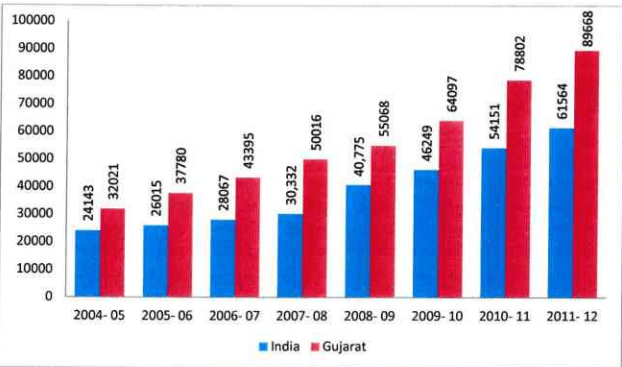
Later in 2009, the New Industrial Policy for the state of Gujarat took into account the context of the current global meltdown. Given the strong and accelerated growth and development exhibited by the state over the recent years, Gujarat is expected to be one of the key drivers for growth in the Indian economy. Gujarat has achieved tremendous growth in the industrial sector and as a result, has emerged as one of the leading industrialized states in India contributing nearly 16.1%3 to the country's industrial output. While Gujarat accounts for 4.99% of India's population, its share in the country's GDP for the year 2011-12 [at constant (2004-05) prices] is 7.61%. Gross State Domestic Product (GSDP) at factor cost at current prices in 2011-12 has been estimated at Rs. 6,11,767 crore registering a growth of 15.3% over the previous year. GSDP at factor cost at constant (2004-05) prices, in 2011-12 has been estimated at Rs. 3,98,884 crore showing an increase of 8.5% during the year. The share of primary, secondary and tertiary sectors is 21.8%, 36.1% and 42.1% respectively to the total GSDP in 2011-12. Gujarat has also registered an increase of 13.8% in the per capita income for 2011-12, which has been estimated at Rs. 89,668 as against Rs. 78,802 in 2010-11, at current prices.
Figure 51: Per Capita Income
The development, in the state has always been a policy-led inclusive development approach which has eventually attached a very high importance to the need for ensuring sustainable development. The new Industrial Policy would therefore capitalize on the inherent entrepreneurial characteristics
Page
of the State. The new Industrial Policy in addition to addressing a wide range of areas of intervention, would also give adequate thrust to ensuring holistic development in the state.
The policy of 2009 mentions the Vision of GoG as "Gujarat aspires to become a beacon of comprehensive social and economic development". The primary policy objectives are as under: (1) Facilitate investments in the state, (2) Employment generation and Employability enhancement and (3) Adherence to high quality standards. The policy thereby indicates the necessary provisioning and the facilitation which would be made by the Government departments and through private entrepreneurs under Public Private Partnership (PPP) framework in the area of facilities like power, water, gas, road, railway, port connectivity, communications, quality human resources in adequate number etc. Since choice for investment is also directly governed by factors of overall physical and social quality of life in the State, adequate interventions have been planned and proposed therein for the purpose.
For the Twelfth Plan period, Gujarat's development vision will be guided by continued emphasis on human development and inclusive growth, while aiming at sustainable double digit growth which is environmentally sustainable with harmonious and balanced development in agriculture, manufacturing and services. Other objectives of the State are:
- Increased livelihood opportunities
• Empowerment of the youth and women
- Improved quality of life, especially of the poor - both in rural and urban areas
• Good governance and improved citizen centric services
- Improved effectiveness, efficiency and transparency in programs directly aimed at the poor
- Meeting the challenges of urbanization especially in terms of infrastructure, services and governance
- Decentralized Planning through ATVT (grass-root level planning and taluka-centric developmental governance), and
- Focused attention on balanced regional development through the State's three flagship programs