2.1.20 Cover
a) A removable plate for permitting access to a pipe, fitting, vessel or appliance.
b) The vertical distance between the top of the barrel of a buried pipe or other construction and the surface of the ground.
2.1.21 Cross-Connection — A connection between two normally independent pipelines which permits flow from either pipeline into the other.
2.1.22 Direct Tap — A tap which is connected to a supply pipe and is subject to pressure from the water main.
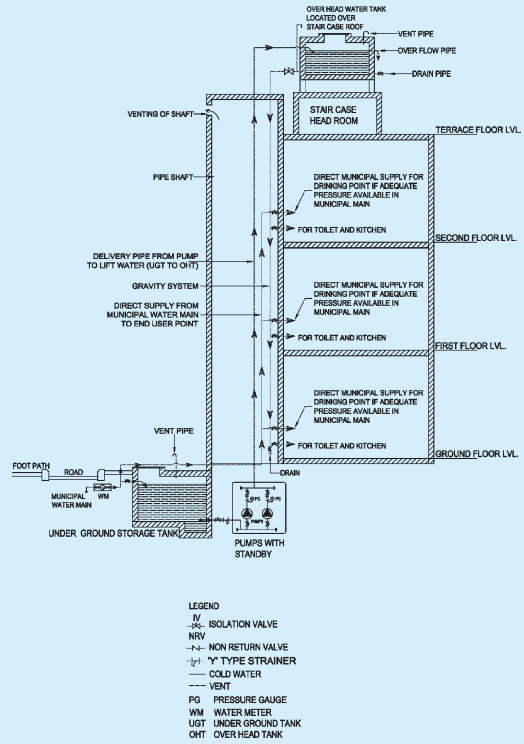
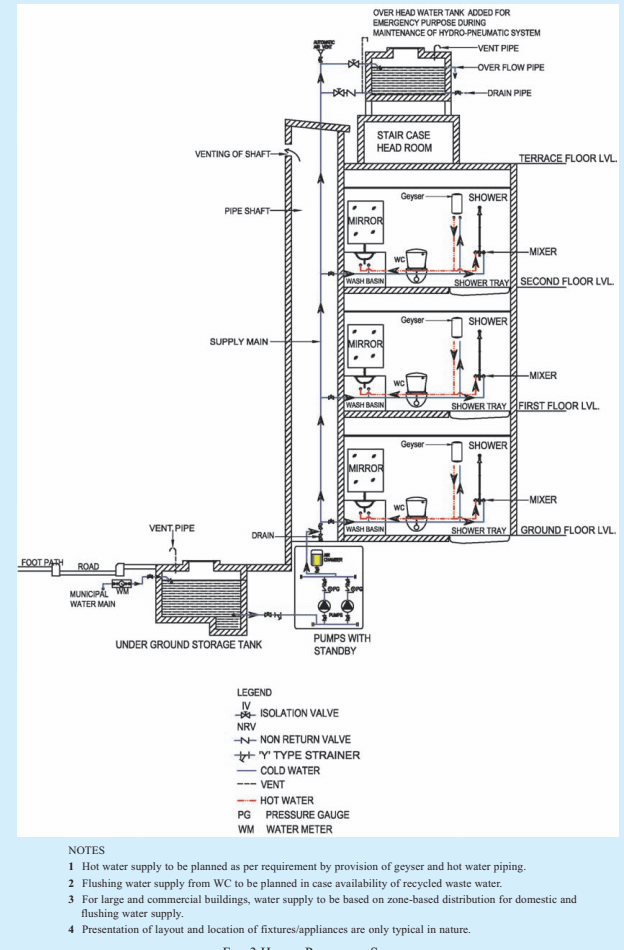
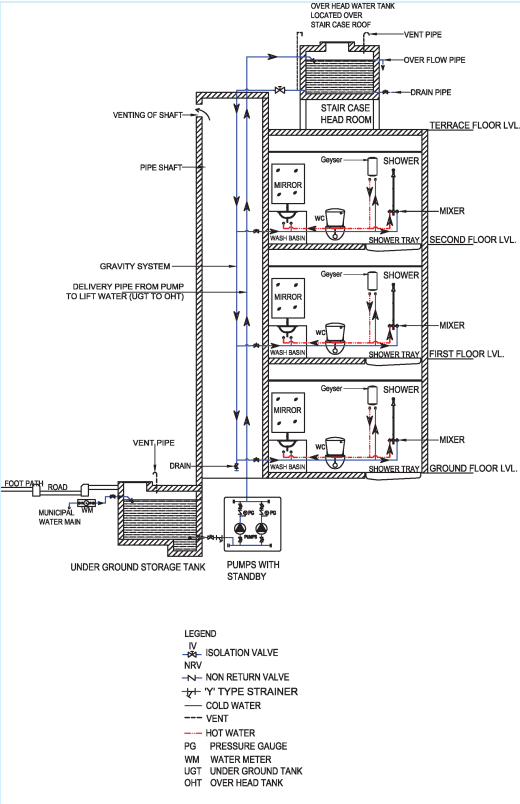
LEGEND
IV
--* ISOLATION VALVE
NRV
--N NON RETURN VALVE
--+ 'Y' TYPE STRAINER
— COLD WATER
--- VENT
PG PRESSURE GAUGE
WM WATER METER
UGT UNDER GROUND TANK
OHT OVER HEAD TANK
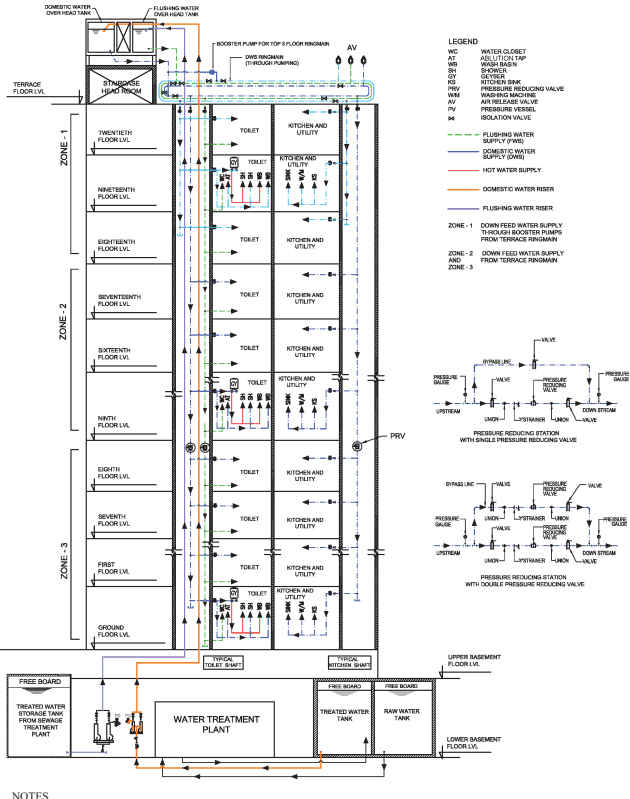
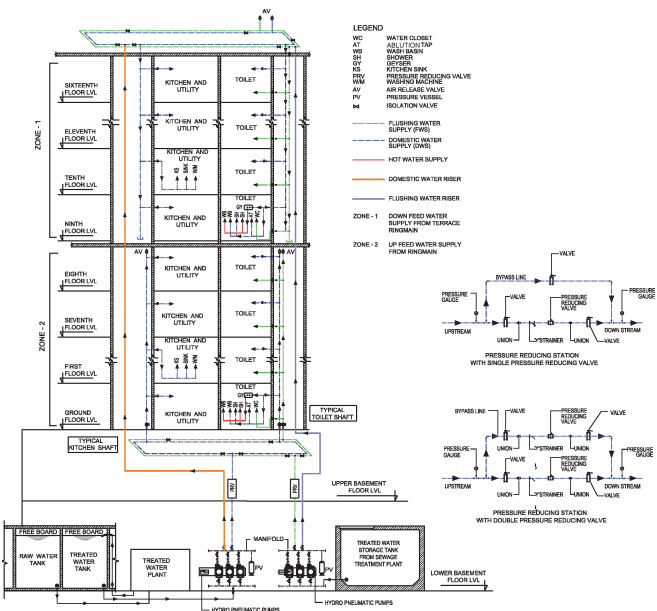
FIG. 1 IDENTIFICATION OF DIFFERENT TYPES OF WATER SUPPLY SYSTEM
2.1.23 Down Take Tap — A tap connected to a system of piping not subject to water pressure from the water main.
2.1.24 Effective Opening — The minimum cross-sectional area at the point of water supply, measured or expressed in terms of,
a) the diameter of a circle; and
b) the diameter of a circle of equivalent cross-sectional area, if the opening is not circular.
2.1.25 Feed Cistern — A storage vessel used for supplying cold water to a hot water apparatus, cylinder or tanks.
2.1.26 Fittings — The appurtenances such as coupling, flange, branch, bend, tees, elbows, unions, waste (with or without plug), P or S trap (with or without vent), stop ferrule, bib tap, pillar tap, bath faucet, water meter, garden hydrant, valves and any other article used in connection with water supply, drainage and sanitation.
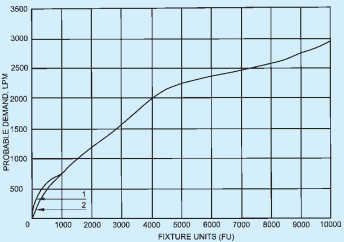
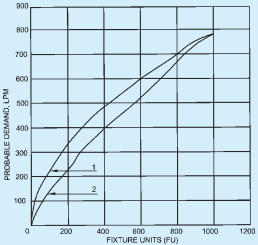
2.1.27 Fixture Unit — A quantity in terms of which the load producing effects on the plumbing system of different kinds of plumbing fixtures is expressed on some arbitrarily chosen scale.
2.1.28 Float Operated Valve — Ball valves or ball taps and equilibrium valves operated by means of a float.
2.1.29 Flushing Cistern — A cistern provided with a device for rapidly discharging the contained water and used in connection with a sanitary appliance for the purpose of cleaning the appliance and carrying away its contents into a drain.
NOTE — The nominal size of a cistern is the quantity of water discharged per flush.
2.1.30 Flushometer Tank –A tank integrated with an air accumulator vessel that is designed to discharge a predetermined quantity of water to fixtures for flushing purposes.
2.1.31 Formation — The finished level of the excavation at the bottom of a trench or heading prepared to receive the permanent work.
2.1.32 Frost Line — The line joining the points of greatest depths below ground level up to which the moisture in the soil freezes.
2.1.33 General Washing Place — A washing place provided with necessary sanitary arrangement and common to more than one tenement.
2.1.34 Geyser — An apparatus for heating water with supply control on the inlet side and delivering it from an outlet.
2.1.35 Haunching — Outward sloping concrete support to the sides of a pipe or channel above the concrete bedding.
2.1.36 Heel Rest Bend or Duck-Foot Bend — A bend, having a foot formed integrally in its base, used to receive a vertical pipe.
2.1.37 High Altitudes — Elevations higher than 1 500 m above mean sea level (MSL).
2.1.38 Highway Authority — The public body in which is vested, or which is the owner of, a highway repairable by the inhabitants collectively; otherwise the body or persons responsible for the upkeep of the highway.
2.1.39 Horizontal Pipe — Any pipe of fitting which makes an angle of more than 45° with the vertical.
2.1.40 Hot Water Tank — A vessel for storing hot water under pressure greater than atmospheric pressure.
2.1.41 Hydro-Pneumatic System—The water supply pumping system which operates automatically in conjunction with pump(s), pressure vessel and pressure switch.
2.1.42 Junction Pipe — A pipe incorporating one or more branches.
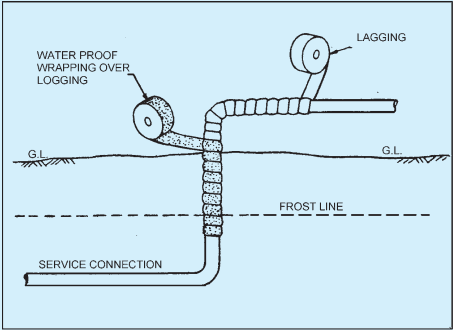
2.1.43 Lagging — Thermal insulation or pipes.
2.1.44 Licensed (or Registered) Plumber — A person licensed (or registered) under the provisions of this Code.
2.1.45 Offset — A pipe fitting used to connect two pipes whose axes are parallel but not in line.
2.1.46 Period of Supply — The period of the day or night during which water supply is made available to the consumer.
2.1.47 Pipe Work — Any installation of piping with its fittings.
2.1.48 Plumbing
a) The pipes, fixtures and other apparatus inside a building for bringing in the water supply and removing the liquid and water borne wastes.
b) The installation of the foregoing pipes, fixtures and other apparatus.
2.1.49 Plumbing System — The plumbing system shall include the water supply and distribution pipes; plumbing fittings and traps; soil, waste, vent pipes and anti-siphonage pipes; building drains and building sewers including their respective connections, devices and appurtenances within the property lines of the premises; and water-treating or water-using equipment.
2.1.50 Potable Water — Water which is satisfactory for drinking, culinary and domestic purposes and meets the requirements of the Authority.
2.1.51 Premises — Premises shall include passages, buildings and lands of any tenure, whether open or enclosed, whether built on or not, and whether public or private in respect of which a water rate or charge is payable to the Authority or for which an application is made for supply of water.
2.1.52 Pressure Balancing Valve – Mixing valve that senses incoming hot and cold water pressures and compensates for fluctuations.
2.1.53 Residual Head — The head available at any particular point in the distribution system.
2.1.54 Residual Pressure — The pressure available at the fixture after allowance is made for pressure drop due to friction loss and head in the system during maximum demand periods.
2.1.55 Saddle — A purpose made fitting, so shaped as to fit over a hole cut in a sewer or drain used to form connections.
2.1.56 Service Pipe — Pipe that runs between the distribution main in the street and the riser in case of a multi-storeyed building or the water meter in the case of an individual house and is subject to water pressure from such main.
2.1.57 Static Pressure — The pressure exerted by a fluid that is not moving or flowing.
2.1.58 Stop-Cock — A cock fitted in a pipe line for controlling the flow of water.
2.1.59 Stop Tap — Stop tap includes stop-cock, stop valve or any other device for stopping the flow of water in a line or system of pipes at will.
2.1.60 Storage Tank — A container used for storage of water which is connected to the water main or tube-well by means of supply pipe.
2.1.61 Studio Apartment— An apartment unit consisting of a single room and a bathroom, the single room functioning as living room, bedroom and kitchen.
2.1.62 Subsoil Water—Water occurring naturally in the subsoil.