9.1 General
Bolted joints suit the requirements of prefabrication in small and medium span timber structures for speed and economy in construction. Bolt jointed construction units offer better facilities as regards to workshop ease, mass production of components, transport convenience and re-assembly at site of work particularly in defence sector for high altitudes and far off situations. Designing is mainly influenced by the species, size of bolts, moisture conditions and the inclination of loadings to the grains. In principle, bolted joints follow the pattern of riveted joints in steel structures.
9.2 Design Considerations
9.2.1 Bolted timber construction shall be designed in accordance with 6. The concept of critical section, that is, the net section obtained by deducting the projected area of bolt-holes from the cross-sectional area of member is very important for the successful design and economy in timber.
9.2.2 Bolt Bearing Strength of Wood
The allowable load for a bolt in a joint consisting of two members (single shear) shall be taken as one half the allowable loads calculated for a three member joint (double shear) for the same ratio. The percentage of safe working compressive stress of timber on bolted joints for different ratios shall be as given in Table 16.
9.2.2.1 Where a number of bolts are used in a joint, the allowable loads shall be the sum of the allowable loads for the individual bolts.
9.2.2.2 The factors for different bolt diameter used in calculating safe bearing stress perpendicular to grain in the joint shall be as given in Table 17.
9.2.3 Dimensions of Members
a) The minimum thickness of the main member in mono-chord construction shall be .
b) The minimum thickness of side members shall be and shall be half the thickness of main members.
c) The minimum individual thickness of spaced member in split-chord construction shall be 20 mm and 25 mm for webs and chord members, respectively.
| Sl No. | Ratio | Stress Percentage | |
| Parallel to Grain | Perpendicular to Grain | ||
| (1) | (2) | (3) | (4) |
| i) | 1.0 | 100 | 100 |
| ii) | 1.5 | 100 | 96 |
| iii) | 2.0 | 100 | 88 |
| iv) | 2.5 | 100 | 80 |
| v) | 3.0 | 100 | 72 |
| vi) | 3.5 | 100 | 66 |
| vii) | 4.0 | 96 | 60 |
| viii) | 4.5 | 90 | 56 |
| ix) | 5.0 | 80 | 52 |
| x) | 5.5 | 72 | 49 |
| xi) | 6.0 | 65 | 46 |
| xii) | 6.5 | 58 | 43 |
| xiii) | 7.0 | 52 | 40 |
| xiv) | 7.5 | 46 | 39 |
| xv) | 8.0 | 40 | 38 |
| xvi) | 8.5 | 36 | 36 |
| xvii) | 9.0 | 34 | 34 |
| xviii) | 9.5 | 32 | 33 |
| xix) | 10.0 | 30 | 31 |
| xx) | 10.5 | — | 31 |
| xxi) | 11.0 | — | 30 |
| xxii) | 11.5 | — | 30 |
| xxiii) | 12.0 | — | 28 |
| Sl No.(1) | Diameter of Bolt mm(2) | Diameter Factor (3) |
|---|---|---|
| i) | 6 | 5.70 |
| ii) | 10 | 3.60 |
| iii) | 12 | 3.35 |
| iv) | 16 | 3.15 |
| v) | 20 | 3.05 |
| vi) | 22 | 3.00 |
| vii) | 25 | 2.90 |
9.2.4 Bolts and Bolting
a) The diameter of bolt in the main member shall be so chosen to give larger slenderness ratio of bolt.
b) There shall be more number of small diameter bolts rather than small number of large diameter bolts in a joint.
c) A minimum of two bolts for nodal joints and four bolts for lengthening joints shall be provided.
d) There shall be more number of rows rather than more bolts in a row.
e) The bolt holes shall be of such diameter that the bolt can be driven easily.
f) Washers shall be used between the head of bolt and wood surface as also between the nut and wood.
9.3 Arrangement of Bolts
9.3.1 The following spacings in bolted joints shall be followed (see Fig. 9):
a) Spacing of bolts in a row — For parallel and perpendicular to grain loading = 4
b) Spacing between rows of bolts
-
For perpendicular to grain loading — to ( for ratio of 2 and for ratio of 6 or more. For ratios between 2 and 6 the spacing shall be obtained by interpolation).
-
For parallel to grain loading — At least
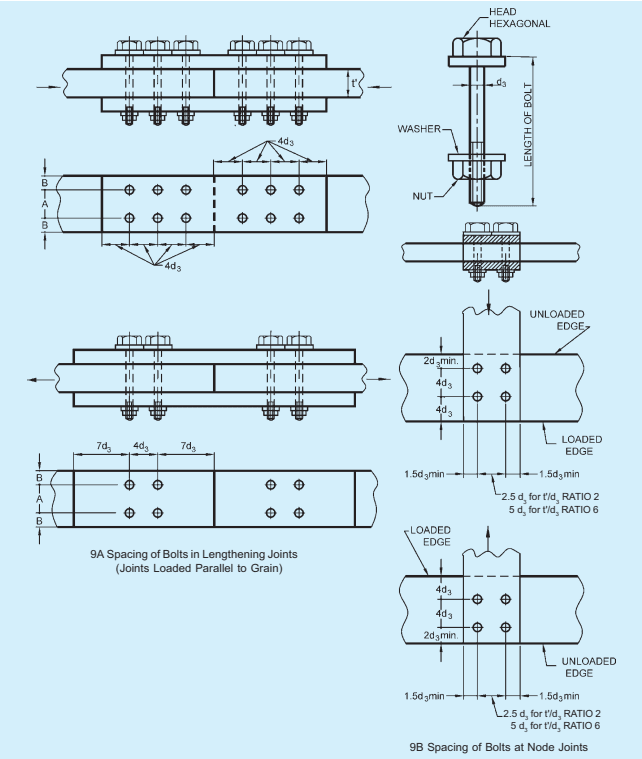
FIG. 9 TYPICAL SPACING OF BOLTS IN STRUCTURAL JOINTS
PART 6 STRUCTURAL DESIGN — SECTION 3 TIMBER AND BAMBOO: 3A TIMBER
with a minimum of . Also governed by net area at critical section which should be 80 percent of the total area in bearing under all bolts.
c) End distance — for softwoods in tension, for hardwoods in tension and for all species in compression.
d) Edge distance
-
For parallel to grain loading or half the distance between rows of bolts, whichever is greater.
-
For perpendicular to grain loading, the loaded edge distance shall be at least .
9.3.2 For inclined members, the spacing given above for perpendicular and parallel to grain of wood may be used as a guide and bolts arranged at the joint with respect to loading direction.
9.3.3 The bolts shall be arranged in such a manner so as to pass the centre of resistance of bolts through the intersection of the gravity axis of the members.
9.3.4 Staggering of bolts shall be avoided as far as possible in case of members loaded parallel to grain of wood. For loads acting perpendicular to grain of wood, staggering is preferable to avoid splitting due to weather effects.
9.3.5 Bolting
The bolt holes shall be bored or drilled perpendicular to the surface involved. Forcible driving of the bolts shall be avoided which may cause cracking or splitting of members. A bolt hole of 1.0 mm oversize may be used as a guide for preboring.
9.3.5.1 Bolts shall be tightened after one year of completion of structure and subsequently at an interval of two to three years.
9.4 Outline for Design of Bolted Joints
Allowable load on one bolt (unit bearing stress) in a joint with wooden splice plates shall not be greater than value of as determined by one of the following equations:
a) For loads parallel to grain:
b) For loads perpendicular to grain:
c) For loads at an angle to grain:
9.5 Fabrication
The fabrication of bolt jointed construction shall be in
accordance with good practice [6-3A(9)].
To meet the specific requirements of ‘all-timber construction’ for structures where chemical corrosion of steel elements is a problem, and in order to erect anti-magnetic laboratories, sheds, etc, design should be made on the basis of mild steel bolt joints with the following reductions for timber bolts and bamboo pins:
Allowable safe working = 66 percent of the safe load per hardwood timber bolt Safe working load per solid bamboo pin = 56 percent of the working load per mild steel bolt