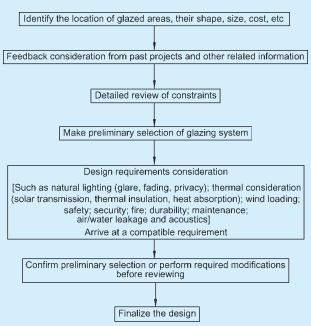
4.1.1 Right from the initial project evaluation stage, a suitable methodology that incorporates the implications of use of glass materials and their influence on performance of the building shall have to be looked into. A typical flowchart outlining such a methodology is provided for the users of this Section (see Fig. 1).
It is assumed that,
a) the location of area to be glazed and its preliminary size/shape have been decided as part of normal building design process.
b) the designer has gained information on glass/ and plastic glazing sheet materials used in similar circumstances.
c) the designer is cognizant of implications of any innovation in design.
4.1.2 Design requirement including aesthetic considerations and client specified requirements such as security and maintenance to be considered.
4.1.3 Effect of design on cost such as initial cost of glazing (specification of glass/plastic sheeting material; glazing method; access for initial glazing; work schedule; protection during construction); effect of glass/plastic sheeting material on capital/running cost related to building heating/cooling, lighting and ventilation; and maintenance cost of glazed areas (access for cleaning and reglazing) should be considered.
FIG. 1 TYPICAL SEQUENCE OF DESIGN EVALUATION FOR GLAZED AREAS
PART 6 STRUCTURAL DESIGN — SECTION 8 GLASS AND GLAZING
4.1.4 Selection of appropriate glass may be done considering the cost benefit analysis in respect of the benefit accrued against the alternatives available. Also, the comparative cost of glazing materials should be considered together with their life expectancy and probability of need for maintenance. In the context of selection of glass, the provisions given in the Part 11 'Approach to Sustainability' of the Code may also be considered in addition to the cost benefit analysis on the use of glass vis-a-vis use of other alternatives. To suitably modify to indicate that the selection of appropriate glass may be made considering the cost benefit analysis in respect of the benefit accrued against the alternatives available.
4.2Types of Glass
4.2.1 The soda lime silicate glass is classified based on the type of internal stress which determines the strength of the glazing towards breakage, design and installation procedure and based on application. Table 1 gives the typical properties of various types of glass.
4.2.2 Normal (Annealed) Glass
For requirements including tests on nominal thickness of annealed (flat) glass {see Table 1 of accepted standard [6-8(3)]}. Flat transparent sheet glass shall conform to the following classes as specified in accepted standard [6-8(3)] namely; A quality or Selected Quality (SQ), B quality or Ordinary Quality (OQ) and C quality or Greenhouse Quality (GQ). Transparent float glass shall be as per accepted standard [6-8(4)].
A transparent flat glass is designated as clear glass when it is not tinted and when its light transmittance after any necessary pre-treatment is greater than the value prescribed in Table 2 for the nominal thickness.
4.2.3 Laminated Glass
4.2.3.1 Laminated glass is a glass configuration made of two or more pieces of glass bonded together by interlayer/interlayers. It is commonly used as a form of safety glass which cracks and breaks under sufficient impact, the broken glass fragments being still held together. When laminated glass is broken, fragments tend to adhere to the interlayer. For requirements of laminated safety glass, accepted standard [6-8(5)] may be referred.
4.2.3.2 Laminated glass does not shatter like ordinary glass. It absorbs impact, resists penetration, and remains intact even if broken, holding glass fragments in place and lowering the risk of injury. Laminated glass is capable to stop flying debris and limit or avoid splintering on opposite side of the impact. When exposed to heat from solar radiation resulting in unequal temperature in the pane, laminated glass breaks but stays in place longer. The risk of thermal breakage is reduced only when heat strengthened/tempered laminated glass is used.
Sl No.
Properties
Annealed Glass
Float Glass
Annealed Laminated Glass
Tempered or Toughened Glass
(1)
(2)
(3)
(4)
(5)
(6)
i)
Modulus of rupture
40 N/mm2
40 N/mm2
40 N/mm2
120 to 200 N/mm2
ii)
Thickness
As per accepted standard [6-8(3)]
As per accepted standard [6-8(4)]
6.38 - 19 mm
3 - 19 mm
iii)
Density (approximate)
←———2 400 – 2 550 kg/m3 ———→
iv)
Modulus of elasticity
←———70 GPa ———→
v)
Coefficient of linear expansion
←——— 9×10⁻⁶ m/m K ———→
vi)
Compressive strength
←———1 000 N/mm2 ———→
NOTE — Conventionally, the following types of glass exist:
a) Annealed (clear) glass.
b) Extra clear glass.
c) Body tinted glass.
d) Coated glass (including Lacquered glass).
1) Online coated glass.
2) Offline coated glass.
e) Processed glass — Each of the glasses (a) to (e) above can be subjected to further processing to produce the following types:
1) Heat strengthened,
2) Toughened or tempered,
3) Double glazed unit,
4) Laminated glass (Single laminated),
5) Laminated double glass unit,
6) Ceramic/screen printed fritted glass (patterned glass), and
7) Fire safety glass.
4.2.3.3 Laminated glass can be made from the following typical combinations:
a) Glass which is float/sheet/patterned/polished wired/wired patterned glass, and may be having the following properties:
clear, tinted or coated;
transparent, translucent or opaque;
annealed, heat strengthened or toughened; and
surface treated (such as acid etched or by sandblast).
b) Plastic glazing sheet material which can be polycarbonate or acrylic and may be having the following properties:
clear, tinted or coated; and
transparent or translucent.
Table 2 Minimum Light Transmittance Value (Designating a Transparent Glass as Clear Glass) (Clause 4.2.2)
Nominal Thickness, mm
2
3
4
5
6
8
10
12
15
19
25
Minimum Value of Light Transmittance, Percent
89
88
87
86
85
83
81
79
76
72
67
c) Interlayers which differ based on material type and composition; mechanical characteristics; and optical characteristics, and may be having the following properties:
Clear or coloured;
Transparent, translucent or opaque; and
Coated.
NOTE — Until standards on plastic glazing sheet materials and interlayers are formulated, they will be subject to the specifications of manufacturers of laminated glazing materials.
4.2.4 Toughened or Tempered Glass
4.2.4.1 Toughened glass is a type of safety glass which is heat treated to a uniform temperature of approximately 650∘ C and rapidly cooled to induce compressive stresses of 75.5 MPa ( 770kg/cm2 ) to 143.4 MPa ( 1462kg/cm2 ) on the surfaces and edge compression of the order of 66.7 MPa ( 680kg/cm2 ). For requirements of toughened safety glass, accepted standard [6-8(5)] may be referred.
4.2.4.2 Toughened glass gains its added strength from the compressed surfaces. However, if a deep scratch or an impact penetrates the surface, the glass shall break into a number of small particles. Any attempt to cut, drill, grind or sand blast the glass after toughening may result in glass breakage. The heat treatment process does not change the light transmission and solar radiant heat properties of the glass.
4.2.4.3 Toughened glass provides greater thermal strength. It increases resistance to both sudden temperature changes and temperature differentials up to 250∘ C compared with normal glass, which can withstand temperature differentials up to 40∘ C only. Thermally toughened glass is approximately four times stronger than annealed glass of the same thickness and configuration, and shall comply with the requirements of accepted standard [6-8(5)]. Toughened glass is difficult to break and when broken, it breaks into many relatively small fragments, which are less likely to cause serious injury to people, as there are no jagged edges or sharp corners like in normal glass. On the contrary, the toughened glass is also susceptible to breakage when hit with a small tap at its edge using a hammer or a
hard object. Toughened glass is often referred to as safety glass because it meets the requirements of the standards which apply to safety glass. Toughened glass cannot be subjected to further processing, such as cutting, drilling, edge grinding after toughening and any alterations such as sandblasting or acid etching will weaken glass and can cause premature failure (see Notes).
Float glass contains some level of imperfection. One type of imperfection is nickel sulphide (NiS) inclusions. Most NiS inclusions are stable and cause no problems. There is, however, the potential for NiS inclusions that may cause spontaneous breakage in fully tempered glass without any load or thermal stress being applied. Heat soak testing is a process that exposes critical NiS inclusions in fully tempered glass. The process involves placing the tempered glass inside a chamber and raising the temperature to approximately 290∘ C to accelerate nickel sulphide expansion. This causes glass containing nickel sulphide inclusions to break in the heat soak chamber, thus reducing the risk of potential field breakage. However, the heat soak process is not 100 percent effective.
1 The process of toughening is used to increase the strength of glass and to produce fracture characteristics that are desirable in many situations. However, the process of toughening can also lead to an increased risk of spontaneous glass fracture (associated with material impurities). Accordingly, the possibility of spontaneous fracture should be taken into account when toughened glass is used.
2 Heat soaking may minimise the risk of nickel sulphide induced spontaneous fracture in toughened glass. Glass manufacturers maybe consulted for advice relating to anticipated nickel sulphide minimization.
4.2.5 Heat Strengthened Glass
Heat strengthened glass is a type of tempered glass which has been strengthened thermally by inducing a surface compression of about 44.3 MPa (422 kg/cm 2 ) to 64.5 MPa (658 kg/cm 2 ) as compared to a range of 75.5 MPa (770 kg/cm 2 ) to 143.4 MPa (1 462 kg/cm 2 ) in case of fully tempered glass. Heat strengthened glass is valued for its mechanical strength, which is twice that of normal annealed glass though half of toughened glass. With the exception of strength and thermal resistance characteristics, heat strengthened glass retains the normal properties of annealed glass. Heat
PART 6 STRUCTURAL DESIGN — SECTION 8 GLASS AND GLAZING
strengthened glass provides necessary resistance to thermal stress associated with high performance glazing materials such as tinted glass and reflective glass. It also provides necessary resistance to heat building up when used as spandrel glass. Heat strengthened glass with its flatter surface also results in the facade having less optical distortions. Heat strengthened glass shall have a surface compression of 24 - 52 MPa.
NOTES
1 Heat strengthening associated with relatively less residual stresses ≤52.0MPa has lower risk of spontaneous glass fracture (associated with material impurities).
2 Surface compression (including fragmentation), four point bending, warp and waviness tests are typically carried out to determine the characteristics of heat strengthened glass.
4.2.6 Reflective Glass
A metallic coating is applied to one side of the glass in order to significantly increase the amount of reflection by the glass of both the visible and infrared (light and heat) ranges of the electromagnetic spectrum. This metallic coating can be applied to clear or body tinted glass, without adversely affecting the transparency of the glass. The reflective glass imparts an enhanced appearance to the exterior of buildings due to the coating of metal oxides on the glass. It is widely applied as an aesthetic and energy efficient product in buildings for its highly reflective surface and wide palette of colours. It reduces heat gain and glare from the exterior and allows optimum visible light transmission to the interior. If designed/used properly, reflective glass can aid at reducing the air conditioning load of buildings
NOTE — Highly reflective glass should be avoided, especially in internal environments. The reflections from these surfaces can be particularly confusing for persons with vision impairment.
4.2.7 Insulating Glass Unit
Insulating glass unit, a prefabricated unit of glass having an edge seal that not only binds the individual sheets of glass together to maintain the mechanical strength of the joint but also protects the cavity between the glasses from outside influences. The moisture in the cavity between the two glasses is controlled by desiccants filled in the perforated spacer. The spacer may be aluminum, composites, plastics, etc. The spacer ensures the precise distance between the glass panes. The cavity is normally filled with dry air but can be also filled with gases such as argon or krypton for better thermal performance. The low heat conductivity of the enclosed dry gas between the glass panes drastically reduces the thermal heat transmission through the glass to 2.8W/m2K (12 mm spacer between two 6 mm glass) as compared to 5.73W/m2K for normal 6 mm glass. It also helps in reducing the direct solar energy specifically when the outer pane is a solar control glass. For sizes greater than 3m2 , the thickness of the spacer
shall be chosen such that physical contact of glass panes (white spots) does not occur.
NOTE — Moisture penetration test and argon/krypton gas level test are typically carried out to determine the characteristic of IGUs.
4.2.8 Wired Glass
The general requirements including thickness, dimensional tolerance and tests for wired glass as specified in accepted standard [6-8(6)] are valid.
4.2.9 Glass Fins
When glass fins are used as a decorative member, it can be either toughened (tempered) or laminated glass.
When glass fins are used as a structural member, it shall be toughened and laminated. The depth and thickness may vary as per elevation and wind load requirements. Design should also accommodate movements. It is recommended to use finite element analysis to determine the appropriate glass fin sizes.
4.3 Application
Glass can be designed/suited to use in building occupancies such as in residential, assembly and mercantile in elements such as façades, windows, doors, partitions, display units, shop fronts, greenhouses (where plants are grown), atrium. Different types of glass are selected based on requirements. For safety against accidental breakage and strength requirement (mechanical and thermal), toughened glass or laminated glass may be considered over annealed glass. For increased high security requirements, acoustic insulation, sloped glazing and skylights, laminated glass may be considered.
4.4Associated Glazing Materials
4.4.1 Structural Sealant
The structural sealant could be of silicone type with requirements meeting the design criteria. Structural sealant shall be shelf-stable, natural-cured, elastomeric adhesive exhibiting the desired adhesion to building substrates. The structural sealant may require cleaning and or priming to get good adhesion for structural glazing application. For laminated glass applications where glass edges are sealed with a sealant, compatibility shall be ensured with the interlayer to avoid delamination.
4.4.2 Gaskets
Gasket is a mechanical seal that fills the space between two mating surfaces, to prevent leakage from or into the joined objects and will be able to deform while under compression and tightly fills the space it is designed for, including any slight irregularities.
4.4.3 Preformed Tape
Typical requirements of preformed butyl and foam tapes shall be as given in Table 3.
4.4.4 Setting Blocks, Location Blocks and Distance Pieces
Setting blocks, location blocks, and distance pieces shall be designed in accordance with 6 which are,
a) resilient, load-bearing, non-absorbent and rot-proof materials; and
b) compatible with all other materials that may come in contact with them.
4.5General Requirements
4.5.1 Glazing and associated materials used for the proper installation shall satisfy the minimum dimensional and framing requirements in accordance with the procedures given in this Section. The dimensional and thickness tolerance of the glass used in exterior and interior is determined from the provisions given hereunder.
4.5.2 Dimensional Requirement
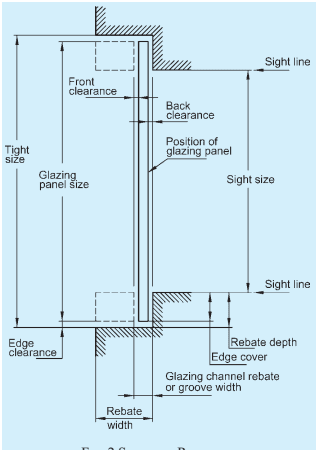
4.5.2.1 The dimensions for edge clearance, edge cover, and front and back clearance, as defined in Fig. 2, shall be not less than the values given in Table 4.
NOTE — For glazing systems where the framing member is aluminium or steel and gaskets are used to capture the glazing, minimum glazing bite of 12.7 mm is recommended for architectural glazing.
4.5.2.2 Front putty width
The front putty width shall be not less than 10mm for panels up to 1m2, and not less than 12mm for panels between 1m2 and 2m2.
Table 3Typical Properties of Preformed Tapes (Clause 4.4.3)
Sl No.
Properties
Requirement
(1)
(2)
(3)
i)
Low temperature flex
No cracks at -23°C
ii)
Weight loss
2 percent, Max
iii)
Vehicle migration
1 paper stained maximum and this stain shall be no more than 3.2 mm from edge of sample maximum
iv)
Backing removal
No transfer of tape compound to the paper
v)
Yield strength
41.4 kPa, Min
vi)
Compression/Recovery
Compression index, 1.22 N/mm2, Max
vii)
Water absorption
Weight gain Max after boiling, 40 kg/m3, Max
viii)
Flow test
Loss of height, 60 percent, Max
4.5.2.3 Dimensions of rebates and grooves (width and depth)
Dimensions of rebates and grooves shall accommodate
FIG. 2 SIZES AND REBATES
the requirements of Table 4 and allow for the appropriate setting and location blocks (see also 6).
4.5.2.4 Glass dimensional tolerance
The tolerance for dimensions shall be as per those in the respective list of Indian Standards.