In mining areas, subsidence of the ground beneath a building or any other structure is liable to occur. The magnitude of the movement and its distribution over the area are likely to be uncertain and attention shall,
therefore, be directed to make the foundations and structures sufficiently rigid and strong to withstand the probable worst loading condition and probable ground movements. Long continuous buildings should be avoided in such areas and large building in such area should be divided into independent sections of suitable size, each with its own foundations. Expert advice from appropriate mining authority should be sought.
NOTE — For prediction of subsidence in coal mines, guidelines as given in the good practice [6-2(8)] may be referred.
6.5.2 Landslide Prone Areas
The construction of structures on slopes which are suspected of being unstable and are subject to landslip shall be avoided.
On sloping ground on clay soils, there is always a tendency for the upper layers of soil to move downhill, depending on type of soil, the angle of slope, climatic
conditions, etc. In some cases, the uneven surface of the slope on a virgin ground will indicate that the area is subject to small land slips and, therefore, if used for foundation, will obviously necessitate special design consideration.
Where there may be creep of the surface layer of the soil, protection against creep may be obtained by following special design considerations.
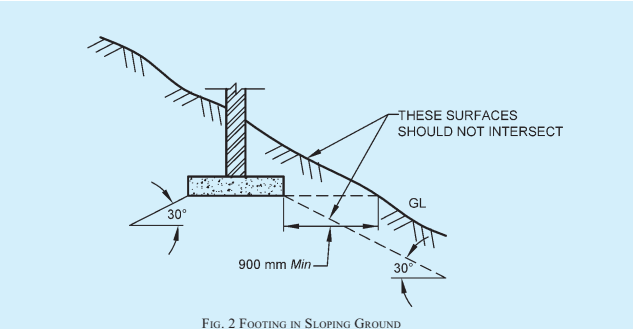
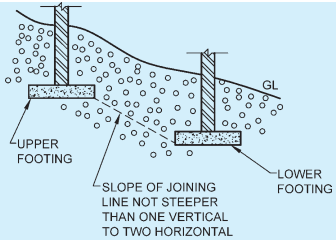
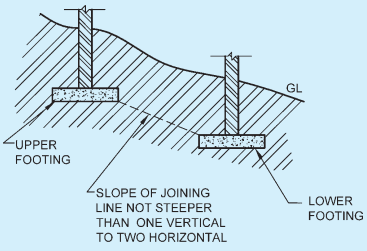
On sloping sites, spread foundations shall be on a horizontal bearing and stepped. At all changes of levels, they shall be lapped at the steps for a distance at least equal to the thickness of the foundation or twice the height of the step, whichever is greater. The steps shall not be of greater height than the thickness of the foundation, unless special precautions are taken.
Cuttings, excavations or sloping ground near and below foundation level may increase the possibility of shear failure of the soil. The foundation shall be well beyond the zone of such shear failure.
If the probable failure surface intersects a retaining wall or other revetment, the latter shall be made strong enough to resist any unbalanced thrust. In case of doubt as to the suitability of the natural slopes or cuttings, the structure shall be kept well away from the top of the slopes, or the slopes shall be stabilized.
Cuttings and excavations adjoining foundations reduce stability and increase the likelihood of differential settlement. Their effect should be investigated not only when they exist but also when there is possibility that they are made subsequently.
Where a structure is to be placed on sloping ground, additional complications are introduced. The ground itself, particularly if of clay, may be subject to creep or other forms of instability, which may be enhanced if the strata dip in the same direction as the ground surface. If the slope of the ground is large, the overall stability of the slope and substructure may be affected. These aspects should be carefully investigated.