6.1 This clause deals with snow loads on roofs of buildings. Roofs should be designed for the actual load due to snow or for the imposed loads specified in 3, whichever is more severe.
NOTE — Mountainous regions in northern parts of India are subjected to snow fall. In India, part of Jammu and Kashmir (Baramulla District, Srinagar District, Anantnag District, and Leh and Kargil District); Punjab and Himachal Pradesh (Chamba, Kullu, Kinnaur District, Mandi District, Sirmaur District and Simla District); and Uttarakhand (Dehra Dun District, Tehri Garhwal District, Almora District, Pithoragarh District and Nainital District) experience snow fall of varying depths two or three times in a year.
6.2 Notations
a) (Dimensionless) — Nominal values of the shape coefficients, taking into account snow drifts, sliding snow, etc, with subscripts, if necessary.
b) (metre) — Horizontal dimension with numerical subscripts, if necessary.
c) (metre) — Vertical dimensions with numerical subscripts, if necessary.
d) (degree) — Roof slope.
e) (pascal) — Snow load on ground.
f) (pascal) — Snow load on roofs.
6.3 Snow Load in Roof(s)
6.3.1 The minimum design snow load on a roof area or
any other area above ground which is subjected to snow accumulation is obtained by multiplying the snow load on ground, by the shape coefficient , as applicable to the particular roof area considered, expressed as:
6.4 Shape Coefficients
6.4.1 General Principles
In perfectly calm weather, falling snow would cover roofs and the ground with a uniform blanket of snow, and the design snow load could be considered as a uniformly distributed load. Truly uniform loading conditions, however, are rare and have usually only been observed in areas that are sheltered on all sides by high trees, buildings, etc. In such a case, the shape coefficient would be equal to unity.
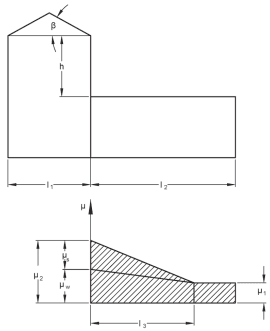
In most regions, snow-falls are accompanied or followed by winds. The winds will redistribute the snow, and on some roofs especially multilevel roofs, the accumulated drift load may reach a multiple of the ground load. Roofs which are sheltered by other buildings, vegetation, etc, may collect more snow load than the ground level. The phenomenon is of the same nature as that illustrated for multilevel roofs in 6.4.2.4.
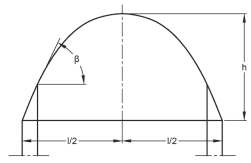
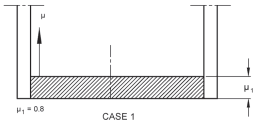
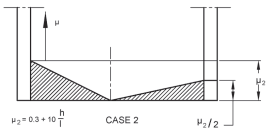
So far, sufficient data are not available to determine the shape coefficient on a statistical basis. Therefore, a nominal value is given. A representative sample of roofs is shown in 6.4.2. However, in special cases such as strip loading, cleaning of the roof periodically by deliberate heating of the roof, etc, have to be treated separately.
The distribution of snow in the direction parallel to the caves is assumed to be uniform.
6.4.2 Shape Coefficients for Selected Types of Roofs
6.4.2.1
Simple Flat and Monopitch Roofs
Simple Pitched Roofs (Positive Roof Slope)