11.1 General
Under-reamed piles are bored cast in-situ and bored compaction concrete types having one or more bulbs formed by enlarging the borehole for the pile stem. These piles are suited for expansive soils which are often subjected to considerable ground movements due to seasonal moisture variations. These also find wide application in other soil strata where economics are favorable. When the ground consists of expansive soil, for example, black cotton soils, the bulb of under-reamed pile provide anchorage against uplift due to swelling pressure, apart from the increased bearing, provided topmost bulb is formed close to or just below the bottom of active zone. Negative slopes may not be stable in certain strata conditions, for example, in pure sands (clean sands with fines less than 5 percent) and very soft clayey strata having N of SPT less than 2 (undrained shear strength of less than 12.5 kN/m²). Hence formation of bulb(s) in such strata is not advisable. In subsoil strata above water table, the maximum number of bulbs in under-reamed pile should be restricted to four. In the strata such as clay, silty clay and clayey silt with high water table where sides of borehole stand by itself without needing any stabilization by using drilling mud or otherwise, the maximum number of bulbs in under-reamed piles should be restricted to two. In strata for example, clayey sand, silty sand and sandy silt with high water table where borehole needs stabilization by using drilling mud, under-reamed piles with more than one bulb shall not be used. In loose to medium pervious strata such as clayey sand, silty sand and sandy silt strata, compaction under-reamed piles may be used as the process of compaction increases the load carrying capacity of piles. From practical considerations, under-reamed piles of more than 10 m depth shall not be used without ensuring their construction feasibility and load carrying capacity by initial load tests in advance. In view of additional anchorage available with the provision of bulbs, under-reamed piles can be used with advantage to resist uplift loads.
11.2 Materials
Provisions of 8.2 shall generally apply.
11.3 Design Considerations
11.3.1 General
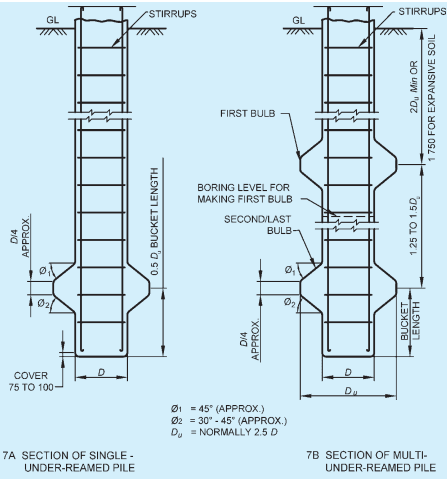
Under-reamed pile foundation shall be designed in such a way that the load from the structure they support can be transmitted to the soil without causing failure of soil or failure of pile material and without causing settlement (differential or total) under permanent transient loading as may result in structural damage and/or functional distress (see Fig. 7).
11.3.1.1 In deep deposits of expansive soils the minimum length of piles, irrespective of any other considerations, shall be 3.5 m below ground level. If the expansive soil deposits are of shallow depth and overlying on non-expansive soil strata of good bearing or rock, piles of smaller length can also be provided. In recently filled up grounds or other strata or poor bearing the piles should pass through them and rest in good bearing strata.
11.3.1.2 The minimum stem diameter of under-reamed pile can be 200 mm up to 5 m depth in dry conditions, that is, strata with low water table. The minimum stem diameter for piles up to 5 m depth in strata with high
water table within pile depth, shall be 300 mm for normal under-reamed pile and 250 mm for compaction under-reamed pile. For piles of more than 5 m depth, the minimum diameter in two cases shall be 375 mm and 300 mm, respectively. The minimum diameter of stem for strata consisting of harmful constituents, such as sulphates, should also be 375 mm.
11.3.1.3 The diameter of under-reamed bulbs may vary from 2 to 3 times the stem diameter, depending, upon the feasibility of construction and design requirements. In bored cast in-situ under-reamed piles and under-reamed compaction piles, the bulb diameter shall be normally 2.5 and 2 times the stem diameter, respectively.
11.3.1.4 For piles of up to diameter, the spacing of the bulbs should not exceed 1.5 times the diameter of the bulb. For piles of diameter greater than , spacing can be reduced to 1.25 times the bulb diameter.
11.3.1.5 The topmost bulb should be at a minimum depth of two times the bulb diameter. In expansive soils it should also be not less than 2.75 m below ground level. The minimum clearance below the underside of pile cap embedded in the ground and the bulb should be a minimum of 1.5 times the bulb diameter.
11.3.1.6 Under-reamed piles with more than one bulb
All dimensions in millimetres.
FIG. 7 TYPICAL DETAILS OF BORED CAST IN-SITU UNDER-REAMD PILE FOUNDATION
PART 6 STRUCTURAL DESIGN — SECTION 2 SOILS AND FOUNDATIONS
are not advisable without ensuring their feasibility in strata needing stabilization of boreholes by drilling mud. The number of bulbs in the case of bored compaction piles should also not exceed one in such strata.
11.3.1.7 Under-reamed batter piles without lining in dry conditions, that is, strata with low water table can be constructed with batter not exceeding .
11.3.2 Safe Load
Safe load on a pile can be determined,
a) by calculating the ultimate load from soil properties and applying a suitable factor of safety as given in Annex J;
b) by load test on pile as good practice [6-2(19)]; and
c) from safe load tables.
11.3.2.1 Load test
Provisions of 8.3.3.1.3 shall generally apply.
11.3.2.2 In the absence of detailed subsoil investigations and pile load tests for minor and less important structures, a rough estimate of safe load on piles may be made from the safe load table given in the good practice [6-2(27)].
NOTE — Safe loads as given in the above referred Table are symptomatic. Safe load carrying capacity of pile shall be worked out for the actual geotechnical data using 5.2.3.1 of good practice [6-2(27)], subjected to confirmation by initial pile load test in accordance with good practice [6-2(19)] and other provisions in 5.2.3.2 of good practice [6-2(27)].
11.3.3 Negative Skin Friction or Dragdown Force
Provisions of 8.3.4 shall generally apply subject to the condition that the under-reamed bulb is provided below the strata susceptible to negative skin friction.
11.3.4 Structural Capacity
Provisions of 8.3.5 shall generally apply except that the under-reamed pile stem is designed for axial capacity as a short column. Under-reamed piles under lateral loads and moments tend to behave more as rigid piles due the presence of bulbs and therefore the analysis can be done on rigid pile basis. Nominally reinforced long single bulb piles which are not rigid may be analyzed as per the method given in Annex G or as per other accepted methods.
11.3.5 Spacing
Generally the centre-to-centre spacing for bored cast in-situ under-reamed piles in a group should be two times the bulb diameter . It shall not be less than . For under-grade beams, the maximum spacing of piles should generally not exceed 3 m. In under-reamed compaction piles, generally the spacing should not be less than . If the adjacent piles are of different
diameter, an average value of bulb diameter should be taken for spacing.
11.3.6 Group Efficiency
For bored cast in-situ under-reamed piles at a usual spacing of , the group efficiency will be equal to the safe load of an individual pile multiplied by the number of piles in the group. For piles at a spacing of , the safe load assigned per pile in a group should be reduced by 10 percent.
In under-reamed compaction piles, at the usual spacing of , the group capacity will be equal to the safe load on an individual pile multiplied by the number of piles in the group.
11.3.7 Transient and Overloading
Provisions of 8.3.9 and 8.3.10 shall generally apply.
11.3.8 Reinforcement
11.3.8.1 The minimum area of longitudinal reinforcement (any type or grade) within the pile shaft shall be 0.4 percent of the sectional area calculate on the basis of outside area of the shaft or casing if used. Reinforcement is to be provided in full length and further a minimum of 3 bars of 10 mm diameter mild steel or three 8 mm diameter high strength steel bars shall be provided. Transverse reinforcement shall not be less than 6 mm diameter at a spacing of not more than the stem diameter or 300 mm, whichever is less.
In under-reamed compaction piles, a minimum number of four 12 mm diameter bars shall be provided. For piles of lengths exceeding 5 m and of 375 mm diameter, a minimum number of six 12 mm diameter bars shall be provided. For piles exceeding 400 mm diameter, a minimum number of six 12 mm diameter bars shall be provided. The circular stirrups for piles of lengths exceeding 5 m and diameter exceeding 375 mm shall be minimum 8 mm diameter bars.
For piles in earthquake prone areas, a minimum number of six bars of 10 mm diameter shall be provided. Also transverse reinforcement in the form of stirrups or helical should be at 150 mm centre-to-centre in top few meter depth.
11.3.8.2 The minimum clear cover over the longitudinal reinforcement shall be 40 mm. In aggressive environment of sulphates, etc, it may be increased to 75 mm.
11.3.9 The design of pile cap and grade beams shall conform to the requirements specified in 8.3.12 and 8.3.13 respectively.
11.4 For detailed information on under-reamed piles regarding control of pile, installation, reference shall be made to good practice [6-2(26)].
11.5 Non-Destructive Testing
For quality assurance of concrete piles, non-destructive integrity test may be carried out prior to laying of beam/caps, in accordance with good practice [6-2(24)].