7.1 General
The provisions herein are limited to the behaviour of glass when subjected to various kinds of human impact, precautions against risk of fall and falling glass. Conditions outside of ‘human impact’ are not covered under the scope of this Section.
This Section does not assume that the glass used in accordance to this Section will not be broken under all human impact conditions, rather,
a) it will not be broken under most likely forms of human impact; and
b) even if it breaks, the likelihood of cutting or piercing injuries will be minimised by virtue of the protection given to the glass, or by the limited size, or by the fracture characteristics of the glass.
Further, this Section does not deal with the safety and security of people or goods in relation to risks of,
-
vandalism, riots, burglary or break in protection;
-
fire arm protection;
-
protection from explosion (terrorist attack);
-
natural disasters like earthquakes, cyclone, fire, etc; and
-
plastic glazing material, safety and security glazing, etc.
In circumstances wherein the requirements of any referred standard(s) exceeds the requirements of this Section, in such cases the higher requirement shall become applicable.
The use of this Section shall also be in conformity with all other relevant standards on fire safety, structural stability, natural disasters, safety and security, etc, in force.
7.2 Safety Glass
Glazing material that are constructed, treated, or combined with other materials so as to reduce, in comparison with ordinary sheet/ float/ plate glass, the likelihood of injury to persons by objects from exterior sources or by these safety glasses when they may be cracked or broken.
The following are the products in the scope of this Section that may be used in safety glazing provided they meet the conformity requirements of accepted standard [6-8(5)]. Safety glass according to this Section
shall be of following types:
a) Toughened safety (Tempered) glass, and
b) Laminated safety glass.
7.2.1 All heat-treated/heat strengthened glasses, laminated, toughened, coated glasses and annealed glasses are not classified as safety glasses unless laminated to meet the requirement of tests specified in accepted standard [6-8(5)] for safety glass.
7.2.2 In atria where there is no impact loads above 10 m, suitable toughened glass is adequate. See 4.2.9, in case of use of glass fins as a structural member.
7.3 Critical Location
Where any glazing is within 1.5 m above the floor level of a building, it is considered likely to be subjected to human impact and hence, shall comply with the human impact safety requirements of this Section. Safety glazing should also be used,
a) where there is danger of falling infill glass material(s) from overhead glazing;
b) the danger of falling due to a change in floor level; and
c) in case of balustrades, stairs and floors.
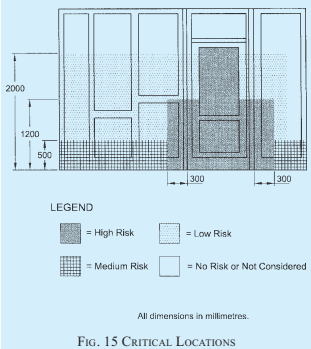
Based on typical accidents in glazed buildings, certain locations in buildings are found to be more vulnerable to human impact than others. Some of such critical locations are shown in Fig. 15, where necessary precautions given below should be followed:
-
In-and-around doors, low windows;
-
Door side panels;
-
Panels mistaken for a doorway or opening;
-
Panels at low levels in walls and partitions;
-
Bathrooms;
-
Building associated with special activities, for example, gymnasia, enclosed swimming pools, etc;
-
Schools and child care facilities; and
-
Nursing homes and care facilities for the aged and infirmed.
Suitable precautions should be taken to reduce the
injuries that can result from glass breakage by,
i) selecting glass of a suitable type, thickness and size;
ii) enhancing a person's awareness of presence of glass by making glass visible (manifestation of glass); and
iii) minimizing manual handling of large pieces of glass during installation.
Based on the above, a comprehensive Table 30 is provided for information.
Table 30 Type of Glass Suggested for Use at Different Critical Locations/Cases in Buildings (Clause 7.3)
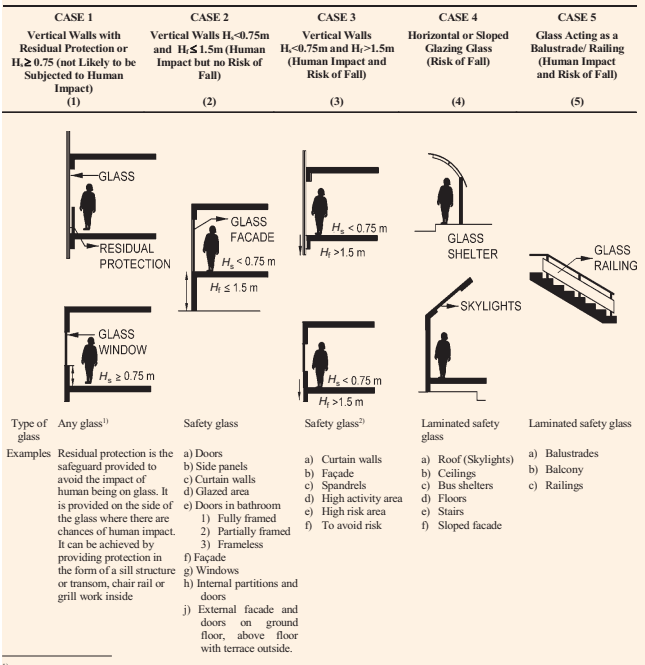
- Safety glass is not mandatory.
Laminated float glass is preferred.
PART 6 STRUCTURAL DESIGN — SECTION 8 GLASS AND GLAZING
Table 30 — (Concluded)
1 ‘’ corresponds to height of fall of human being or glass in case of change in level and ‘’ corresponds to the sill height with reference to floor height. 2 In case of mirror glazing, it should conform to the requirements of other safety glasses unless it is fully backed by a solid material. 3 In Case 2 and Case 3, if the smaller dimension of the pane is 250 mm or less and its area is 0.5 m² or less, glass other than safety glass may be used, provided that its nominal thickness is not less than 6 mm (applicable to vertical glazing). 4 Toughened or laminated safety glass should meet respective test requirements as given in respective Indian Standard specifications. 5 The effective toughened safety glass thickness and/or laminated safety glass configuration shall be determined case by case with regard to, a) other solicitations (wind load, snow load, dead load, and human load); b) the overall dimension (length, width of surface); c) the aspect ratio of the glass; and d) the glazing fixing type (framing, bolted system, structural system, etc). 6 Precautions against chances of injuries due to broken glass falling on people include: a) Broken annealed glass falling on people can cause grievous or even fatal injuries; hence it is recommended to use safety glass in locations other than defined in case 1 where the risk of people getting hurt by falling glass is high. b) Toughened safety (tempered) glass has a safe breakage pattern, as it breaks and disintegrates into small and relatively harmless particles. However, thick toughened glass particles may stay interlocked, and fall as lumps of these multiple particles and can cause a minor or medium injury mainly due to the weight of the cluster. c) Laminated safety glass shall generally not fall out of fixing. However, where laminated glass with both glasses toughened, used for horizontal or sloped glazing, in case of failure of both toughened glasses, it may crumble as a blanket and fall out of fixing. This factor needs to be considered while designing horizontal and sloped glazing. Further, when the slope is acute, inner pane facing the floor should be laminated; and when the slope is obtuse, the outer pane facing the ground / floor should be laminated and all obtuse angle sloped glazing shall be continuously capped for safety reasons. d) Any broken glass in any glazing should be removed immediately on breakage. e) Strength of the glazing system should be such that it has the ability to hold glass in place and prevent it from falling out as a whole. f) For over-head applications like skylights, canopies for the safety of maintenance workers and people underneath, the broken laminated glass shall be capable of sustaining a load of 100 kg for a minimum duration 30 min. 7 In case of external laminated glass facades, openable portions have to be left at regular distances for fire fighting and smoke exhaust. This portion should be of toughened (safety tempered) glass and clearly indicated by suitable visible marking. See also Part 4 ‘Fire and Life Safety’ of the Code. 8 If insulating glass unit (IGU) is used in situations mentioned in this Section, then one of the following shall apply: a) If IGU is installed in areas subjected to human impact on either side, then both the panes of the unit shall meet the requirements of this Section. b) In situations where access is restricted to one side of the unit, then only the accessible side should meet the requirements of this Section. 9 Enhance person’s awareness of presence of glass by making visible manifestation. 10 For specific provisions relating to smoke evacuation, Part 4 ‘Fire and Life Safety’ of the Code may be referred.
7.4 Manifestation (Making Glass Visible)
7.4.1 Presence of glass in a door, side panel or a panel capable of being mistaken for a doorway or opening, which is not made apparent by transoms, colonial bars, door frames, large door handles, stall or other components of glazing system, should be made apparent by some form of manifestation. Decorative treatment, such as being opaque, or patterned are the other common manifestation options.
The manifestation employed should be of a sufficient size to make it immediately obvious. The manifestation should preferably be permanent, for example etching of the glazing; alternatively, if applied materials are used, they should be durable and not easily removed.
Manifestation shall be in the form of an opaque band in accordance with B-5.3.13 of Part 3 'Development Control
Rules and General Building Requirements' of the Code.
7.4.2 A band or marking may not be required, where any one of the following applies:
a) Width of the glass is not greater than 500 mm at any part (this applies to overall panel assembly — not individual glass pieces as in faceted glazing).
b) Glass is provided with at least one fixed glazing bar, firmly attached to the styles to locate and protect each face of the glass. At least one transom (glazing bar) shall be located with its upper edge not less than 500 mm and its bottom edge not more than 1 000 mm above the floor level. The glazing bar shall have a face of width mm; and
c) Alternatively, patterns may be used as an acceptable form of marking provided it meets the other criteria in this Section.
7.5 Identification
All safety glasses shall be procured from certified manufacturers and the product shall conform to relevant Indian Standards and shall carry all relevant information through the approved label/permanent (indelible) markings on the glass surface.
7.6 Test Requirements
7.6.1 Safety glass shall conform to all the requirements when tested as per the test methods mentioned in the relevant Indian Standards or as listed in Table 31.
7.6.2 Mechanical Strength
The required mechanical strength values (see Table 32) apply to quasi-static loading over a short time like wind loading relate to 5 percent probability of breakage at the lower limit and 95 percent confidence intervals.
| Sl No. | Requirements | Laminated Safety Glass | Toughened Safety Glass | Test Requirement as per |
| (1) | (2) | (3) | (4) | (5) |
| i) | Impact/ Resistance to shock | YES | YES | |
| ii) | Fragmentation test | — | YES | |
| iii) | Warp test | — | YES | |
| iv) | Boil test | YES | — | Accepted Standard [6-8(5)] |
| v) | Fracture and Adhesion test | YES | — | |
| vi) | Light stability test | YES | — | |
| vii) | UV light test | YES (for glass used in the exterior portions and subject to natural light) | — | |
| viii) | Shot bag impact test | YES | YES | see Annex E |
| NOTES | ||||
| 1 Bake test (high temperature) and humidity test may also be carried out as an option to determine the characteristics of laminated safety glass. | ||||
| 2 Surface compression test, four point bending test and waviness may also be carried out to determine such characteristics. | ||||
| Sl No. | Type of Glass | Mechanical StrengthN/mm2 |
|---|---|---|
| (1) | (2) | (3) |
| i) | Float (Clear/ Tinted/ Coated/ Mirror) | 120 |
| ii) | Enameled flat (Based on enamelled surface in tension) | 75 |
| iii) | Patterned glass | 90 |
If the glass satisfy the relevant impact test performance requirements (or fragmentation test for toughened glass), in addition to all other appropriate tests mentioned in available Indian Standards or as listed in Table 32, these materials can be classified as safety glass.