B-1 The coated glass that is used for the exterior building of commercial and non-commercial (residential building) should meet the test requirement listed in this Annex.
B-2 Measurements of Performance
The performance factors and spectral details of the coated glass shall be determined using standard accepted spectrophotometer equipment. The actual size shall be dependent on the type of equipment being used for the measurements. The transmittance of the measurement sample shall be measured with radiation of normal incidence at the following wavelengths:
a) 550 nm (representative wavelength for light and solar transmittance); and
b) (representative wavelength for solar transmittance).
For glass claiming to have a low emissivity coating, a measurement of the reflectance shall be made at using radiation of nearly normal incidence.
B-3 Condensation Resistance Test
B-3.1 This test consists of subjecting the coated glass to a water saturated atmosphere at constant temperature. The samples have condensation continually forming on them and it is this condensation that may cause surface degradation.
B-3.2 Test apparatus should have a provision of four test pieces and the materials used for the inner walls shall be corrosion-resistant and shall not affect the test pieces.
B-3.3 Procedure
a) The water tank shall be filled with demineralized water, having conductivity lower than 30 S/cm and a pH higher than 5. The internal temperature of the cabinet shall be controlled by means of the reference
thermocouple keeping a temperature of the reference glass piece of .
b) The test cabinet shall be in a room with an ambient temperature of . Care shall be taken to ensure that draughts, dust, moisture and solar radiation do not interfere with the test cabinet.
c) The reference temperature shall be reached within 2 h of commencing heating. Condensation shall be seen to form on the glass pieces. The test is continued without interruption for the required time. Both the internal reference and the external air temperature shall be regularly checked.
B-3.4 Requirements
a) No defect, greater than length.
b) Maximum one defect between and length.
c) Maximum five defects between 1 mm and 2 mm length.
d) No scratches, staining of the coating or clusters of pinholes greater than 1 mm.
e) When compared with the reference test piece, in both reflection and transmission, there shall be no significant colour change. This observation shall be made within 20 s.
f) The transmittance measured at 550 nm and 900 nm shall differ by no more than ±0.03 from the corresponding measured value on the reference test piece.
B-4 Acid Resistance Test
B-4.1 This test consists of subjecting the coated glass to a sulphur dioxide saturated atmosphere at constant temperature. The samples shall have condensation continually forming on them. It is this condensation together with the quantity of sulphur dioxide that may cause surface degradation. Test apparatus should have
PART 6 STRUCTURAL DESIGN — SECTION 8 GLASS AND GLAZING
a provision of four test pieces and the material used for the inner walls shall be corrosion-resistant and shall not affect the test pieces.
B-4.2 Procedure
a) The test cabinet contains 2 litre of demineralized water having conductivity lower than 30 S/cm When the cabinet is closed 0.2 litre of shall be added and the heating system switched on.
b) The test consists of a repetition of 24 h cycles (see Fig. 16).
c) Each cycle consists of high temperature plus condensation period and an ambient temperature without condensation period.
d) The temperature shall increase to in less than 1.5 h. During the next 6.5 h the test pieces shall be subjected to condensation in the atmosphere.
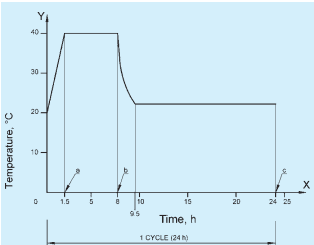
b – Cessation of heating the cabinet and ventilation of the cabinet c – Solution removal rinsing of cabinet
FIG. 16 24-HOUR CYCLE OF HEATING
B-4.3 Requirement
The transmittance measured at 550 nm and 900 nm shall differ by no more than ±0.03 nm from the corresponding measured value on the reference test piece.
B-5 Neutral Salt Spray
B-5.1 This test consists of subjecting the coated glass to neutral, water saline atmosphere at constant temperature. It is the water saline spray that may cause surface degradation.
Test apparatus should have a provision of four test pieces and the material used for the inner walls shall be corrosion-resistant and shall not affect the test pieces.
B-5.2 Procedure
a) The test cabinet shall be prepared and run for a minimum period of 24 h before the test pieces are placed within it. The neutral salt solution is made up by dissolving NaCl, in demineralized water having conductivity lower than 30 S/cm, to produce a concentration of 50 5 g/l at 25 2°C.
b) The compressed air supplied to the spray nozzle shall be passed through a filter to remove all traces of oil or solid matter and shall be at an absolute pressure of 70 kPa to 170 kPa through a saturator at C. The spray nozzle shall be made of inert material, with baffles to prevent direct impact of spray on the test pieces.
B-5.3 Requirements
a) No defect, greater than length;
b) Maximum one defect between 2 mm and 3 mm length;
c) Maximum five defects between 1 mm and 2 mm length;
d) No scratches, staining of the coating or clusters of pinholes greater than 1 mm;
e) When compared with the reference test piece, in both reflection and transmission, there shall be no significant colour change. This observation shall be made within 20 s; and
f) The transmittance measured at 550 nm and 900 nm shall differ by no more than ±0.03 nm from the corresponding measured value on the reference test piece.
B-6 Abrasion Resistance Test
B-6.1 This test consists of subjecting the coated surface of the coated glass to rubbing with a felt pad in dry condition. It is the type of pad, the loading on it and the number of strokes that may cause surface degradation.
B-6.2 Procedure
a) The metal finger shall be approximately 15 mm to 20 mm in diameter and shall be driven so as to produce a frequency of 60 strokes/min + 6 strokes/min alternating forwards and backwards. The stroke length shall be mm. The strokes shall be parallel and ensure a constant pressure over the zone to be tested.
b) A circle shape with a diameter of mm.
c) The test sequence shall commence within 30 min of the sample being cleaned.
d) The metal finger containing the felt pad shall be lowered on to the glass surface and a load of 4 N applied perpendicular to the glass surface via the felt pad.
B-6.3 Requirements
a) Ensure that the abraded area is uniform.
b) The transmittance measured at 550 nm and 900 nm shall differ by no more than ± 0.03 nm from the corresponding measured value on the reference test piece.
B-7 Duration of Tests
The duration of tests shall be as per the following:
| Sl No. | Test | Test Duration for Class | ||
| A(3) | B(4) | S(5) | ||
| i) | Condensation resistance | 21 days | 4 days | 14 days |
| ii) | Acid resistance | 5 cycles | 1 cycle | 5 cycle |
| iii) | Neutral salt spray | 21 days | 10 days | — |
| iv) | Abrasion resistance | 500stokes | 50stokes | 500stokes |
| NOTES | ||||
| 1 Class A — The coated surface of the glass can be positioned on the outer or the inner face of the building. | ||||
| 2 Class B —The coated glass can be used as monolithic glazing but the coated surface shall be on the inner face of the building. | ||||
| 3 Class S — The coated surface of the glass can be positioned on the outer or the inner face of the building but these types of coated glasses can only be used in specifically defined applications. | ||||