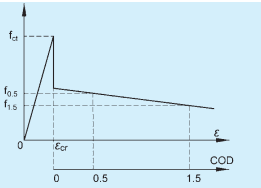
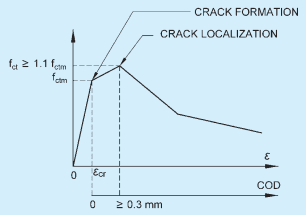
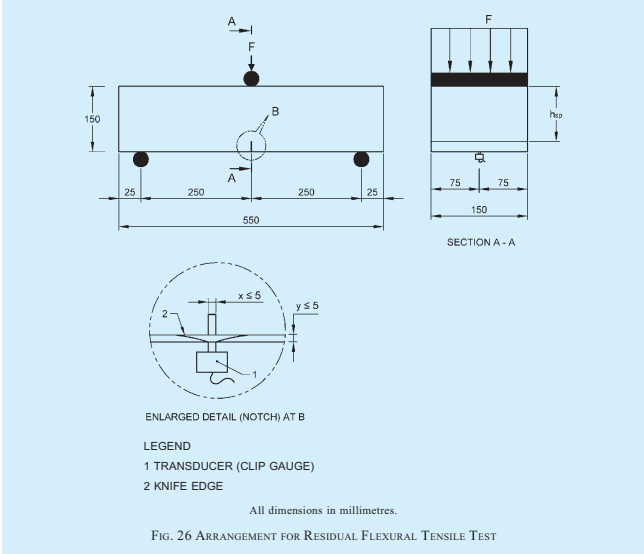
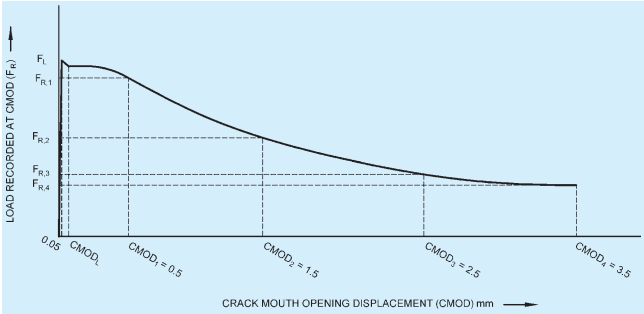
The residual tensile strength shall be obtained using the testing arrangement shown in Fig. 27 and with the following criteria:
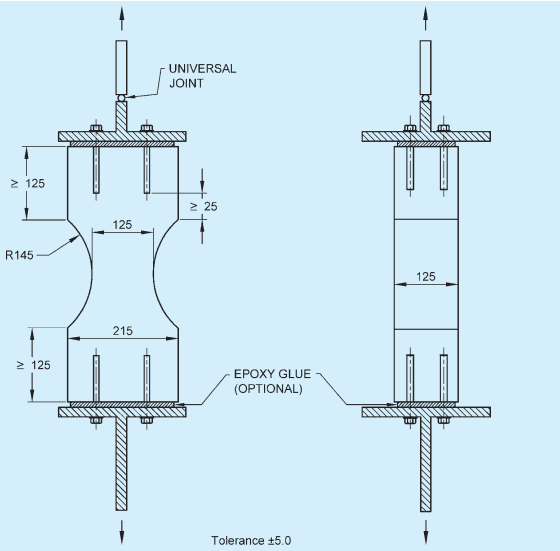
All dimensions in millimetres.
NOTE — There is considerable discussion in the literature on whether the ends of the specimens should be fixed at each end, pinned at each end or fixed at one end and pinned at the other. The adoption of one pinned and one fixed end is a pragmatic decision between the ideal condition (fixed at each end) and limitations in manufacturing of specimens that are perfectly square at their ends for alignment within the testing machine. With both ends fixed any misalignment induces a moment in the specimen during gripping. This moment can induce a tensile stress on one side of the specimen, weakening the specimen. In some situations, the moment induced may be sufficient to crack the concrete. The inclusion of the universal joint at one end eliminates residual tensions that may result from the gripping procedure.
FIG. 27 Testing Arrangement for Direct Tension
a) The critical section shall be where the cross-sectional area is a minimum.
b) The SFRC mix shall be batched to ensure a uniform distribution of fibres, and shall be placed in the moulds in a manner that does not interfere with the distribution of the fibres. The SFRC shall be compacted using lightly applied external vibration.
c) The specimen shall be connected to the testing machine in such a manner that the machine does not apply a load to the specimen during the process of tightening of the grips and prior to testing.
d) One end of the specimen shall be connected to the testing machine through a universal joint such that no moment is applied to the end of the specimen.
e) Displacement measurements shall be taken on each of the four sides with the COD taken as the average of these measurements.
f) A minimum of twelve specimens shall be tested.
Tests where the failure of the specimen is outside of the testing region, or where the results are influenced by the test specimen boundaries, shall be retested.
h) The characteristic values of the tensile strength f0,∗ and f1,5∘ corresponding to CODs of 0.5 mm and 1.5 mm, respective ]y, shall be determined statistically as the 95 percentile confidence value assuming the population is normally distributed.
j) The mean values of f0,5m and f1.5m, corresponding to CODs of 0.5 mm and 1.5 mm, respectively, shall be determined
statistically as the 50th percentile confidence value assuming the population is normally distributed.
The stress results obtained from the test shall be multiplied by the three-dimensional orientation factor k1 , where,
And ℓf is the length and b is taken as the average of the width and depth of the specimen taken at the critical section.
NOTE — The factor k removes the influence of the boundaries on the fibre distribution and converts the results of the test to a state where the fibres can be considered to be randomly orientated in three-dimensional space.