Effective Length of Columns
E-1 In the absence of more exact analysis, the effective length of columns in framed structures may be obtained from the ratio of effective length to unsupported length given in Fig. 32 when relative displacement of the ends of the column is prevented and in Fig. 33 when relative lateral displacement of the ends is not prevented. In the latter case, it is recommended that the effective length ratio may not be taken to be less than 1.2.
NOTES
1 Figures 31 and 32 are reproduced from ‘The Structural Engineer’ No. 7, Volume 52, July 1974 by the permission of the Council of the Institution of Structural Engineers, U.K.
2 In Figs. 31 and 32, and are equal to:
where the summation is to be done for the members framing into a joint at top and bottom respectively; and and being the flexural stiffness for column and beam, respectively.
E-2 To determine whether a column is a no sway or a
sway column, stability index may be computed as given below:
where
sum of axial loads on all column in the storey,
elastically computed first order lateral deflection,
total lateral force acting within the storey, and
height of the storey.
If , then the column in the frame may be taken as no sway column, otherwise the column will be considered as sway column.
E-3 For normal usage assuming idealized conditions, the effective length of the compression member in a given plane may be assessed on the basis of Table 32.
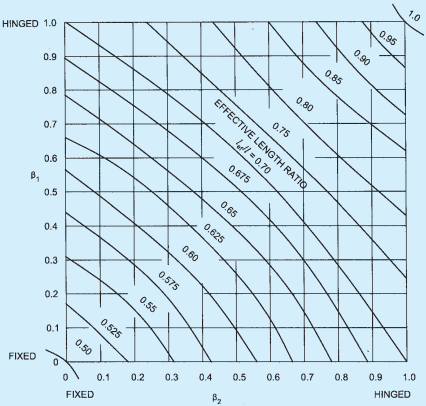
FIG. 32 EFFECTIVE LENGTH RATIOS FOR A COLUMN IN A FRAME WITH No SWAY
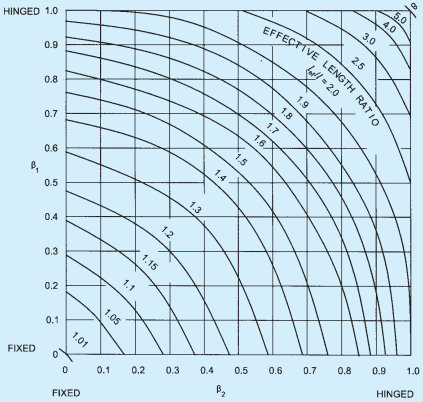
FIG. 33 EFFECTIVE LENGTH RATIOS FOR A COLUMN IN A FRAME WITHOUT RESTRAINT AGAINST SWAY
PART 6 STRUCTURAL DESIGN — SECTION 5 CONCRETE: 5A PLAIN AND REINFORCED CONCRETE
| Sl No.(1) | Degree of End Restraint of Compression Members(2) | Symbol(3) | Theoretical Value of Effective Length(4) | Recommended Value of Effective Length(5) |
| i) | Effectively held in position and restrained against rotation at both ends | 0.50 l | 0.65 l | |
| ii) | Effectively held in position at both ends, restrained against rotation at one end | 0.70 l | 0.80 l | |
| iii) | Effectively held in position at both ends, but not restrained against rotation | 1.00 l | 1.00 l | |
| iv) | Effectively held in position and restrained against rotation at one end, and at the other restrained against rotation but not held in position | 1.00 l | 1.20 l | |
| v) | Effectively held in position and restrained against rotation at one end, and at the other partially restrained against rotation but not held in position | - | 1.50 l | |
| vi) | Effectively held in position at one end but not restrained against rotation, and at the other end restrained against rotation but not held in position | 2.00 l | 2.00 l | |
| vii) | Effectively held in position and restrained against rotation at one end but not held in position nor restrained against rotation at the other end | 2.00 l | 2.00 l | |
| NOTE - l is the unsupported length of compression member. | ||||