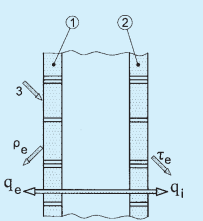
The solar direct absorptance αe shall be calculated from the following formula:
5.3.6 Secondary Heat Transfer Factor Towards the Inside
5.3.6.1 Boundary conditions
For the calculation of the secondary heat transfer factor towards the inside, qi , the heat transfer coefficients of the glazing towards the outside, he , and towards the inside, hi , are needed. These values mainly depend on the position of the glazing, wind velocity, inside and outside temperatures and, furthermore, on the temperature of the two external glazing surfaces.
As the purpose of this Section is to provide basic information on the performance of glazing, the following conventional conditions have been stated for simplicity:
a) Position of the glazing: vertical;
b) Outside surface: wind velocity approximately 4 m/s; corrected emissivity 0.837;
c) Inside surface: natural convection; emissivity optional; and
d) Air spaces are unventilated.
Under these conventional, average conditions, standard values for he and hi are obtained:
where
εi = corrected emissivity of the inside surface [for soda lime glass, εi = 0.837 and hi = 8 W/m²K].
If other boundary conditions are used to meet special requirements they shall be stated in the test report.
Values for εi lower than 0.837 (due to surface coatings with higher reflectance in the far infrared) should only to be taken into account if condensation on the coated surface can be excluded.
5.3.6.2 Single glazing
The secondary heat transfer factor towards the inside, qi, of single glazing shall be calculated using the following formula:
where
αe= solar direct absorptance obtained from the in accordance with 5.3.2, and
he,hi= heat transfer coefficients towards the outside and inside, respectively, in accordance with 7.6.1.
5.3.6.3 Double glazing
The secondary heat transfer factor towards the inside, qi, of double glazing shall be calculated using the following formula:
where
αe1= solar direct absorptance of the outer (first) pane within the double glazing;
αe2= solar direct absorptance of the second pane within the double glazing;
Λ = thermal conductance between the outer surface and the innermost surface of the double glazing (see Fig. 8), in Watt Per square metre per Kelvin (W/m 2 K); and
PART 6 STRUCTURAL DESIGN — SECTION 8 GLASS AND GLAZING
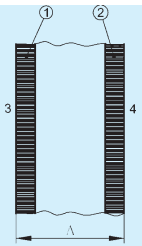
KEY
1 PANE 1
2 PANE 2
3 OUTSIDE
4 INSIDE
FIG. 8 ILLUSTRATION OF THE MEANING OF THERMAL CONDUCTANCE, Λ
he,hi= heat transfer coefficients towards the outside and the inside, respectively in accordance with 5.3.6.1.
Characteristics αe1 and αe2 are calculated as follows:
where
τ1(λ),τ2(λ),ρ1(λ),ρ1′(λ) and ρ2(λ) are as defined in light transmittance.
α1(λ)= spectral direct absorptance of the outer pane, measured in the direction of the incident radiation, given by the relationship:
α1′(λ)= spectral direct absorptance of the outer pane, measured in the opposite direction to the incident radiation, given by the relationship: α1′(λ)=1−τ1(λ)−ρ1′(λ)
α2(λ)= spectral direct absorptance of the second
pane, measured in the direction of the incident radiation, given by the relationship:
Δλ and the integration procedure are the same as in 5.1.11.4 except that the data points shall be chosen at the wavelengths given in Table 11.
The thermal conductance Λ shall be determined for a temperature difference of ΔT=15∘C across the sample and a mean temperature of the sample of 10∘C , or by measuring methods using the standard guarded hot plate method, or the standard heat flow metre method.
If another temperature difference ΔT across the sample and/or another mean temperature of the sample is used for the determination of the thermal conductance Λ to meet special requirements, this shall be stated in the test report.
5.3.6.4 Multiple glazing with n>2 components
The secondary heat transfer factor towards the inside, qi, of a multiple glazing with more than two components shall be calculated using the following formula:
where
αe1 = solar direct absorptance of the outer (first)
pane within the n-fold glazing;
αe2 = solar direct absorptance of the second pane within the n-fold glazing;
αen= solar direct absorptance of the nth (inner) pane of the n-fold glazing;
he,hi= heat transfer coefficients towards the outside and towards the inside, respectively in accordance with 5.3.6.1;
Λ12 = thermal conductance between the outer surface of the outer (first) pane and the centre of the second pane (see Fig. 9);
Λ(n−1)n= thermal conductance between the centre of the (n−1)th pane and the outer surface of the nth (inner) pane (see Fig. 9); and
Λ23 = thermal conductance between the centre of the second pane and the centre of the third pane (see Fig. 9);
The thermal conductances Λ12, Λ23......Λ(n−1)n shall be determined by iteration technique. The calculation of the direct solar absorptances αe1,αe2,…,αen shall be performed using the methods given in 5.3.6.3.
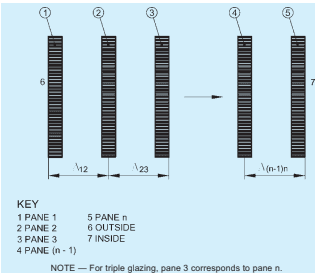
FIG. 9 ILLUSTRATION OF THE MEANING OF THE THERMAL CONDUCTANCES Λ12,Λ23…Λ(n−1)n
As an example for the calculation of the direct solar absorptances the following procedure is given which consist of the following (n−1) steps for a glazing consisting of n components:
a) First step — Calculate the spectral characteristics of a unit consisting of (n−1)
components 2, 3,......n according to what has been prescribed in 5.1.11.4 and 6.1. Then combine this unit with the first (outer) pane as a double glazing.
b) Second step — Calculate the spectral characteristics of a unit consisting of the (n−2) components 3, ..., n and furthermore, those of a double glazing consisting of pane 1 and pane 2. These units are then combined as a double glazing. The sum αe1+αe2 is then obtained. This procedure is continued up to the last (n−1)th step.
c) (n−1)th step — Combine the (n−1) panes 1,2,… (n−1) and determine the spectral characteristics of this unit. This unit is then combined with the nth (inner) pane as a double glazing. From the second equation in 5.3.6.3, the sum αe1,αe2 ... αe(n−1) is obtained, that is with the known values αe1,αe2,…αe(n−2) from the previous steps αe(n−1) is determined. αen is obtained according to the expression of αe2 in 5.3.6.3.
In the case of triple glazing for the solar absorptances αe1, αe2 and αe3 as a function of the spectral characteristics of the individual components of the unit, the following formulae are obtained:
\alpha_ {e 1} = \frac {\sum_ {\lambda = 3 0 0 \mathrm{nm}} ^ {2 5 0 0 \mathrm{nm}} \left\{\alpha_ {1} (\lambda) + \frac {\tau_ {1} (\lambda) \alpha_ {1} ^ {\prime} (\lambda) \rho_ {2} (\lambda) \left[ 1 - \rho_ {2} ^ {\prime} (\lambda) \rho_ {3} (\lambda) \right] + \tau_ {1} (\lambda) \tau_ {2} ^ {2} (\lambda) \alpha_ {1} ^ {\prime} (\lambda) \rho_ {3} (\lambda)}{\left[ 1 - \rho_ {1} ^ {\prime} (\lambda) \rho_ {2} (\lambda) \right] \cdot \left[ 1 - \rho_ {2} ^ {\prime} (\lambda) \rho_ {3} (\lambda) \right] - \tau_ {2} ^ {2} (\lambda) \rho_ {1} ^ {\prime} (\lambda) \rho_ {3} (\lambda)} \right\} S _ {\lambda} \Delta \lambda}{\sum_ {\lambda = 3 0 0 \mathrm{nm}} ^ {2 5 0 0 \mathrm{nm}} S _ {\lambda} \Delta \lambda} \\ \alpha_ {e 2} = \frac {\sum_ {\lambda = 3 0 0 \mathrm{nm}} ^ {2 5 0 0 \mathrm{nm}} \left\{\frac {\tau_ {1} (\lambda) \alpha_ {2} (\lambda) \left[ 1 - \rho_ {2} ^ {\prime} (\lambda) \rho_ {3} (\lambda) \right] + \tau_ {1} (\lambda) \tau_ {2} (\lambda) \alpha_ {2} ^ {\prime} (\lambda) \rho_ {3} (\lambda)}{\left[ 1 - \rho_ {1} ^ {\prime} (\lambda) \rho_ {2} (\lambda) \right] \cdot \left[ 1 - \rho_ {2} ^ {\prime} (\lambda) \rho_ {3} (\lambda) \right] - \tau_ {2} ^ {2} (\lambda) \rho_ {1} ^ {\prime} (\lambda) \rho_ {3} (\lambda)} \right\} S _ {\lambda} \Delta \lambda}{\sum_ {\lambda = 3 0 0 \mathrm{nm}} ^ {2 5 0 0 \mathrm{nm}} S _ {\lambda} \Delta \lambda} \\ \alpha_ {e 3} = \frac {\sum_ {\lambda = 3 0 0 \mathrm{nm}} ^ {2 5 0 0 \mathrm{nm}} \left\{\frac {\tau_ {1} (\lambda) \tau_ {2} (\lambda) \alpha_ {3} (\lambda)}{\left[ 1 - \rho_ {1} ^ {\prime} (\lambda) \rho_ {2} (\lambda) \right] \cdot \left[ 1 - \rho_ {2} ^ {\prime} (\lambda) \rho_ {3} (\lambda) \right] - \tau_ {2} ^ {2} (\lambda) \rho_ {1} ^ {\prime} (\lambda) \rho_ {3} (\lambda)} \right\} S _ {\lambda} \Delta \lambda}{\sum_ {\lambda = 3 0 0 \mathrm{nm}} ^ {2 5 0 0 \mathrm{nm}} S _ {\lambda} \Delta \lambda} \end{array}
where
τ1(λ),τ2(λ),τ3(λ),ρ1(λ),ρ1′(λ),ρ2(λ),ρ2′(λ),ρ3(λ) are as defined in light transmittance;
α1(λ),α1′(λ) and α2(λ) are as defined in 5.3.6.3 double glazing;
α2′(λ)= spectral direct absorptance of the second pane, measured in the opposite direction to the incident radiation, given by the relationship:
α3(λ)= spectral direct absorptance of the third pane, measured in the direction of the incident radiation, given by the relationship:
Δλ and the integration procedure are the same as in 5.1.11.4 except that the data points shall be chosen at the wavelengths given in Table 5.
PART 6 STRUCTURAL DESIGN — SECTION 8 GLASS AND GLAZING
For a glazing with more than three components, the formulae for the solar absorptances αe1,αe2,…,αen as a function of the individual components.
5.3.6.5 Mean radiant temperature (MRT)
MRT can be calculated by various methods, among which measuring with globe thermometer is the most common and is given by:
where
Ta= air temperature, in Kelvin;
Tg = black globe temperature, in Kelvin;
εg= emissivity of black globe;
σ= Stefan-Boltzmann constant; and
hcg= convective heat transfer coefficient of the black globe.