11.1 Developments in the field of synthetic adhesive have brought gluing techniques within the range of engineering practice. Timber members of larger cross-sections and long lengths can be fabricated from small
sized planks by the process of glulam. The term glued laminated timber construction as applied to structural members refers to various laminations glued together, either in straight or curved form, having grain of all laminations essentially parallel to the length of the member.
PART 6 STRUCTURAL DESIGN — SECTION 3 TIMBER AND BAMBOO: 3A TIMBER
11.1.1 Choice of Glue
The adhesive used for glued laminated assembly are ‘gap filling’ type. A ‘filler’ in powder form is introduced in the adhesive. Structural adhesives are supplied either in powder form to which water is added or in resin form to which a hardener or catalyst is added. For choice of glues, reference may be made to accepted standard . However, it is important that only boiling water proof (BWP) grade adhesives shall be used for fabrication of glulam in tropical, high humid climates like India.
11.1.2 Manufacturing Schedule
In absence of a systematic flow-line in a factory, provisions of intermediate technology shall be created
for manufacturing structural elements. The schedule involves the following steps:
a) Drying of planks;
b) Planing;
c) End-jointing by scarfs or fingers;
d) Machining of laminations;
e) Setting up dry assembly of structural unit;
f) Application of glue;
g) Assembly and pressing the laminations;
h) Curing the glue lines, as specified; and
j) Finishing, protection and storage.
11.1.3 The information with regard to block shear test results on glued timber joints is given in Table 18.
| Table 18 Block Shear Test Results on Glued Timber Joints(Clause 11.1.3) | ||||
| SI No. | Timber Species | Ultimate Shear Stress(Inside Location) | ||
| Solid Timber Along the Grain (Un-Jointed)(3) | With Urea Formaldehyde(4) | With Phenol Formaldehyde(5) | ||
| (1) | (2) | |||
| i) | Abies pindrow (Fir) | 5.984 | 7.652 | 9.614 |
| ii) | Acacia catechu (Khair) | 15.107 | 7.456 | — |
| iii) | Acacia milotica (Babul) | 14.126 | 5.199 | 3.237 |
| iv) | Albizia Odoratissima (Karasiris) | 15.009 | 14.126 | 5.984 |
| v) | Azadirachta indica (Neem) | 12.557 | 7.259 | 8.240 |
11.2 Design of Glued Laminated Beams
11.2.1 General
Glued laminated structural members shall be fabricated only where there are adequate facilities for accurate sizing and surfacing of planks, uniform application of glue, prompt assembly, and application of adequate pressure and prescribed temperature for setting and curing of the glue. Design and fabrication shall be in accordance with established engineering principles and good practice. A glued laminated beam is a straight member made from a number of laminations assembled both ways either horizontally or vertically (see Fig. 13). While vertical laminations have limitations in restricting the cross-section of a beam by width of the plank, horizontally laminated section offers wider scope to the designer in creating even the curved members. Simple straight beams and joists are used for many structures from small domestic rafters or ridges to the light industrial structures.
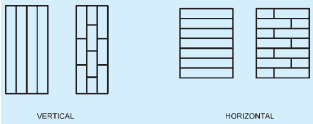
FIG. 13 POSSIBLE ORIENTATION OF PLANKS IN GLULAM
11.2.2 Design
The design of glue laminated wood elements shall be in accordance with good engineering practice and shall take into consideration the species and grade of timber used, presence of defects, location of end joints in laminations, depth of beams and moisture contents expected while in service. Beams of large spans shall be designed with a suitable camber to assist in achieving the most cost effective section where deflection governs the design. The strength and stiffness of laminated beams is often governed by the quality of outer laminations. Glued laminated beams can be tapered to follow specific roof slopes across a building and/or to commensurate with the varying bending moments. Glulam allows the engineers to mix grades within a beam. Obviously, the lower tensile portion should be of high grade material. However, it is possible to incorporate a considerable volume of lower grade material near the neutral axis taking care of the horizontal shear stress. Similarly, species can also be mixed depending upon the modulus of elasticity.
Straight beams that will be simply supported should be cambered during fabrication to allow for deflection due to dead loads over a period of time. The usual camber
is , unless otherwise specified.